
Summarize the Content of the Blog





Why SOAR deployments stall before they reduce MTTR
Most Splunk SOAR deployments deliver the platform but not the outcome. The Phantom-to-SOAR rename, the addition of 300-plus app integrations, the introduction of community playbooks (covered in why Splunk SOAR is a must-have for SOC teams in 2026) — all of this is real. None of it automatically reduces MTTR.
What reduces MTTR is the right set of playbooks running against the right alert categories with the right human-in-the-loop checkpoints. Most stalled SOAR deployments share three patterns: too many playbooks built for edge cases instead of high-volume use cases, playbooks that try to be fully autonomous when the SOC isn’t ready for that level of automation, and no measurement framework to know which playbooks actually contribute to MTTR reduction.
The five patterns below cover the highest-volume SOC workflows in most US enterprise environments. Each is documented in the official Splunk Security Content playbook library and the Splunk SOAR community playbooks. The patterns reflect what the SANS 2025 SOC Survey identified as the most impactful automation areas. For broader context on how this fits into the security operations pipeline, see the full threat-detection to automated-response pipeline.
Pattern 1: Phishing enrichment and response
Phishing is the single most-automated use case in production SOAR deployments. The Splunk research catalog lists more than 20 published phishing playbooks covering ingestion, enrichment, account locking, message eviction, and DNS denylisting across major email and identity platforms.
The reference pattern:
- Ingest the suspicious email from a reporting mailbox (Microsoft 365, Google Workspace, dedicated phishing inbox).
- Enrich with threat intelligence: domain reputation lookup (Cisco Talos, Cisco Umbrella Investigate, PhishTank), attachment hash analysis (CrowdStrike, VirusTotal), URL detonation (sandbox).
- Verify with a junior-analyst-aided checkpoint for borderline cases. Clear-malicious indicators bypass the checkpoint.
- Contain: delete the message from all recipient mailboxes (Microsoft Graph for Office 365, G Suite for Gmail), DNS-blocklist the malicious domain (Cisco Umbrella, AD LDAP), lock impacted user accounts where credential capture is suspected.
- Notify and close: update the incident in ServiceNow or your ticketing platform, log the action chain in SOAR, send a confirmation to the reporting user.
Production MTTR for phishing tickets in environments running this playbook typically drops from 30 to 90 minutes (manual analyst triage) to 2 to 5 minutes (automated end-to-end with human approval on borderline cases). The Splunk SOAR community has documented this reduction across multiple published playbook releases.
Pattern 2: Malware containment
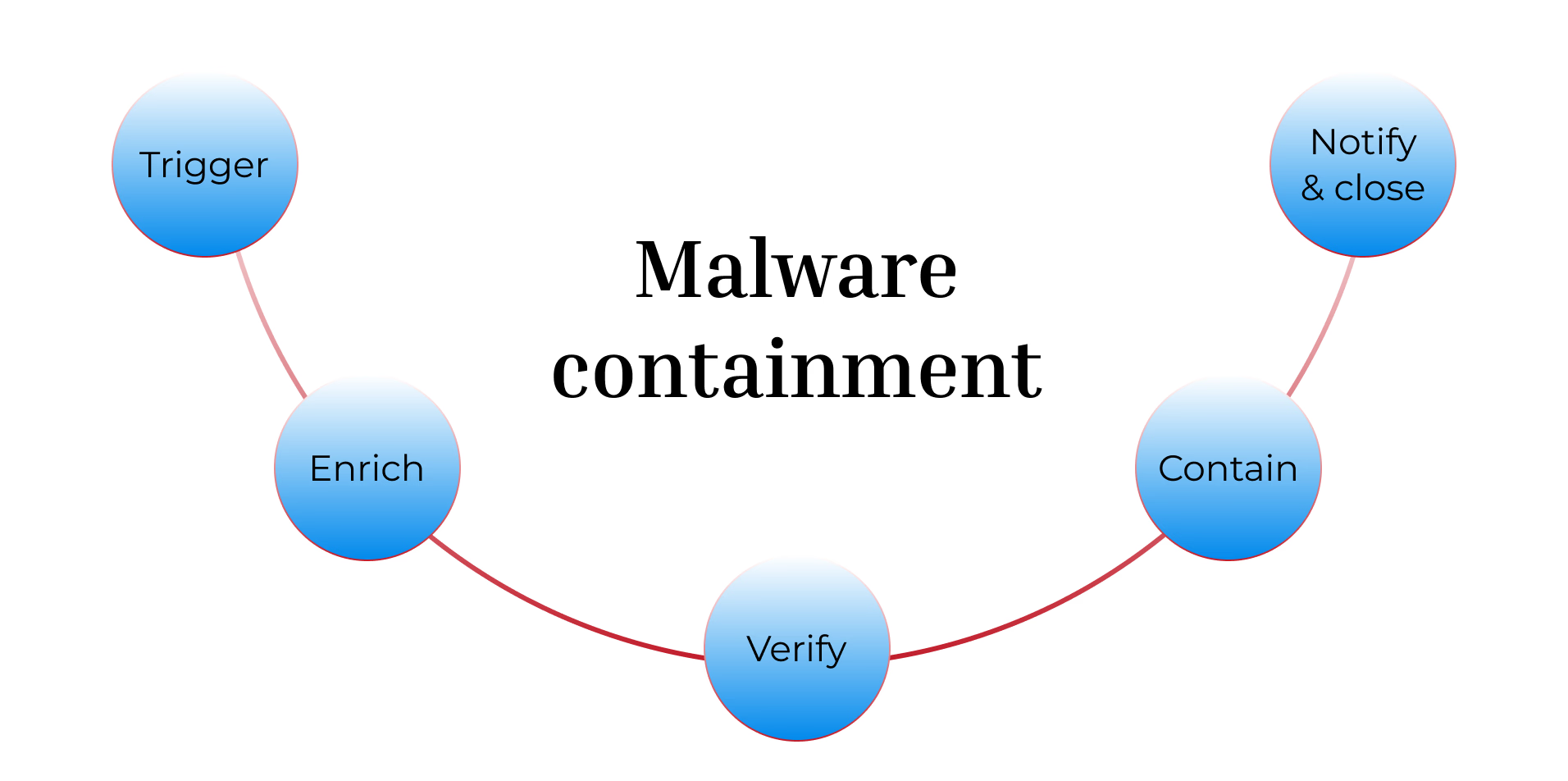
Endpoint malware detection is the second-highest-volume SOAR use case. The pattern combines endpoint detection (CrowdStrike, Microsoft Defender, SentinelOne), enrichment, and containment actions.
The reference pattern:
- Trigger on an EDR detection (CrowdStrike OAuth API, similar feeds).
- Enrich with file hash analysis (VirusTotal, Cisco Talos, internal threat intel), process tree investigation (CrowdStrike Endpoint Analysis), and identifier reputation analysis.
- Verify by comparing against known-good-process whitelist and checking for analyst-flagged false positives.
- Contain: isolate the endpoint from the network (CrowdStrike, Microsoft Defender, network ACL), kill the malicious process, block the file hash across the endpoint fleet.
- Notify and close: create a ServiceNow ticket assigned to endpoint security, notify the affected user’s manager if appropriate, log the chain.
Containment time drops from 20 to 60 minutes (manual analyst-driven response) to under 2 minutes (automated containment with parallel analyst notification). The Splunk security content library publishes a Splunk-supported reference implementation.
Pattern 3: Suspicious login response
Account takeover (ATO) is the third high-volume SOAR pattern and overlaps with the Identifier Reputation Analysis playbooks Splunk publishes through the Dispatch playbook library.
The reference pattern:
- Trigger on an authentication anomaly correlation search in Splunk Enterprise Security (impossible travel, repeated failure followed by success, login from new high-risk geography, login from anonymizer IP).
- Enrich with user identity context (AD LDAP, Azure AD Graph), geolocation lookup, IP reputation analysis.
- Verify with a risk-based alerting score. Below threshold, escalate to analyst. Above threshold, proceed automatically.
- Contain: lock the affected account (AD LDAP, Azure AD, AWS IAM), force MFA re-authentication, terminate active sessions on identity provider.
- Notify: SMS or email the user requesting authentication reset confirmation, notify SOC, create incident ticket.
This pattern is particularly effective in financial services environments where account takeover leads directly to fraud loss. See Splunk SOAR detecting fraudulent payments in real-time for the BFSI-specific application. MTTR on account takeover incidents drops from hours (manual investigation, manual account action) to under 3 minutes (automated containment with parallel verification).
Pattern 4: Threat intelligence correlation
The fourth pattern is enrichment-focused rather than containment-focused. It adds external threat context to every incident without taking automated containment action. Most mature SOCs run this pattern across every Splunk ES notable event.
The reference pattern:
- Trigger on any incoming notable event from Splunk ES correlation searches.
- Enrich each indicator in the notable event with multiple threat intelligence sources: domain and IP reputation (Cisco Talos, Recorded Future, MISP, internal feeds), file hash reputation (VirusTotal, ReversingLabs), user context (AD attributes, role membership), asset context (CMDB, vulnerability state, exposure tier).
- Score and prioritize with risk-based alerting. High-risk score events route to senior analyst. Medium-risk events route to the junior analyst queue. Low-risk events auto-close with the enriched context preserved for audit.
- Document and close with full enrichment context attached to the incident record.
This pattern does not automate containment. It automates the 60 to 80 percent of analyst time spent on data gathering before any human decision is needed. A senior analyst opening an incident with full enrichment already attached reaches a decision in 3 to 5 minutes instead of 30 to 45 minutes of manual lookup. For broader context, see how AI-powered MDR accelerates incident response.
Pattern 5: IT and security team handoff
The fifth pattern addresses one of the consistent friction points in modern SOC operations: the handoff between security and IT teams during incident response. The Splunk SOAR Prompt-Driven Automation documentation describes this pattern specifically.
The reference pattern:
- Trigger when an incident response action requires coordination with a non-security team: network firewall rule change, server isolation, application rollback, identity policy change.
- Generate a structured handoff prompt through Slack, Microsoft Teams, ITOps platforms, or ticketing systems. The prompt includes the incident summary, the proposed action, the affected systems, the time-criticality, and the requested approval.
- Track the handoff with timeout escalation. If no response in 5 minutes, escalate to backup approver. If still no response in 10 minutes, escalate to incident commander.
- Execute the approved action through the SOAR integration with the target system (network ACL change, firewall rule, IAM policy).
- Close the loop with confirmation back to the SOC analyst and audit trail in the incident record.
This pattern removes a category of MTTR latency that pure-security automation cannot reach: the wait time for cross-team approval. Production environments running this pattern report 50 to 75 percent reduction in cross-team handoff MTTR.
How to measure playbook effectiveness
A playbook that runs without measurement is a script, not an automation program. Three metrics matter for every production SOAR playbook.
Mean time to respond (MTTR) for incidents handled by the playbook, compared to baseline manual handling. Track per-playbook MTTR monthly and identify the playbooks with the most material reduction.
False-positive rate of the playbook’s containment actions. A playbook that locks 50 accounts a month with a 30 percent false-positive rate is creating more business friction than security value. Track containment actions against confirmed-malicious determinations.
Coverage rate of the playbook’s intended incident category. A phishing enrichment playbook should fire on 90 percent or more of phishing incidents in the environment. Coverage gaps surface where the trigger logic needs tuning.
A monthly SOAR playbook review covering these three metrics across the top five to ten playbooks is the operational discipline that converts a deployed SOAR into a measurably better-performing SOC. For the broader SOC context, see empowering CIOs through Splunk SOAR integration.
Frequently Asked Questions