Summarize the Content of the Blog





The AI-for-Splunk landscape in 2026
The phrase “AI for Splunk” covers a wider terrain than the marketing positioning suggests. In 2026, the practical landscape divides into three layers.
Layer 1: Native Splunk AI features. Capabilities Splunk has built directly into the platform: Event iQ for ITSI notable event correlation, AI-powered detection in Splunk Enterprise Security 8.x, the Machine Learning Toolkit (MLTK) for custom ML models on Splunk data, adaptive thresholding in ITSI, and the broader agentic AI direction announced at .Conf 2025 (covered in the .Conf 2025 wrap-up: bitsIO’s AI-first approach).
Layer 2: Partner-built AI products. Capabilities partners have built on top of Splunk to address specific pain points the native platform does not solve directly. The most differentiated partner-built AI portfolios cover Splunk ROI optimization, SIEM migration acceleration, IT operations automation, and digital resilience. bitsIO publishes four named products in this layer: datasensAI, QsensAI, resilifyAI, and raasAI.
Layer 3: Custom AI deployments. ML models built by enterprise data science teams or system integrators using Splunk MLTK or external ML platforms with Splunk as the data source. This layer is the longest-running of the three (Splunk has supported MLTK since 2017) and produces the most variable outcomes depending on data quality and model governance.
The ROI conversation lives in Layer 1 and Layer 2 for most enterprise buyers. Layer 3 produces high outcomes in mature data-science organizations and high disappointment in less mature ones. This pillar focuses on Layers 1 and 2 where the ROI is more reliably measurable. For the underlying technology context, see Splunk’s 2025 AI/ML enhancements.
Native Splunk AI features (what Splunk ships)
Splunk’s native AI capabilities in 2026 cluster into four areas.
Event iQ in Splunk ITSI. Released in 2025, Event iQ uses AI to identify correlation patterns in notable event streams that the operations team has not manually configured. The Splunk documentation describes it as a system that “learns from your actual data, finding patterns and ranking fields by importance.” It is most effective when applied after manual NEAP and source tuning are in place (covered in seven techniques for ITSI alert noise reduction).
AI-powered detection in Splunk ES 8.x. Splunk Enterprise Security 8.x extends the platform’s detection capabilities with risk-based alerting calibrated through machine learning. The detection logic learns from analyst feedback over time, surfacing patterns and escalating signals that resemble previously-confirmed-malicious activity. The Splunk ES 8.2 release adds AI-augmented intelligence and unified workflows specifically for SOC operations.
Machine Learning Toolkit (MLTK). The longest-standing native Splunk AI capability. MLTK supports custom ML models built on Splunk-indexed data covering anomaly detection, forecasting, classification, and clustering. Custom ML use cases are typically built by enterprise data science teams or by Splunk Professional Services partners during deeper engagements.
Adaptive thresholding. ITSI’s machine learning-based threshold setting that calibrates KPI alert thresholds against historical distribution per entity per time period. Most useful for cyclical KPIs where static thresholds produce predictable false-positive patterns.
Native Splunk AI is foundational. It works well when applied to the right use cases by the right teams. Most native Splunk AI features increase in effectiveness when paired with the broader Splunk ecosystem investment (NEAPs, correlation searches, RBA tuning).
Partner-built AI products (what extends Splunk)
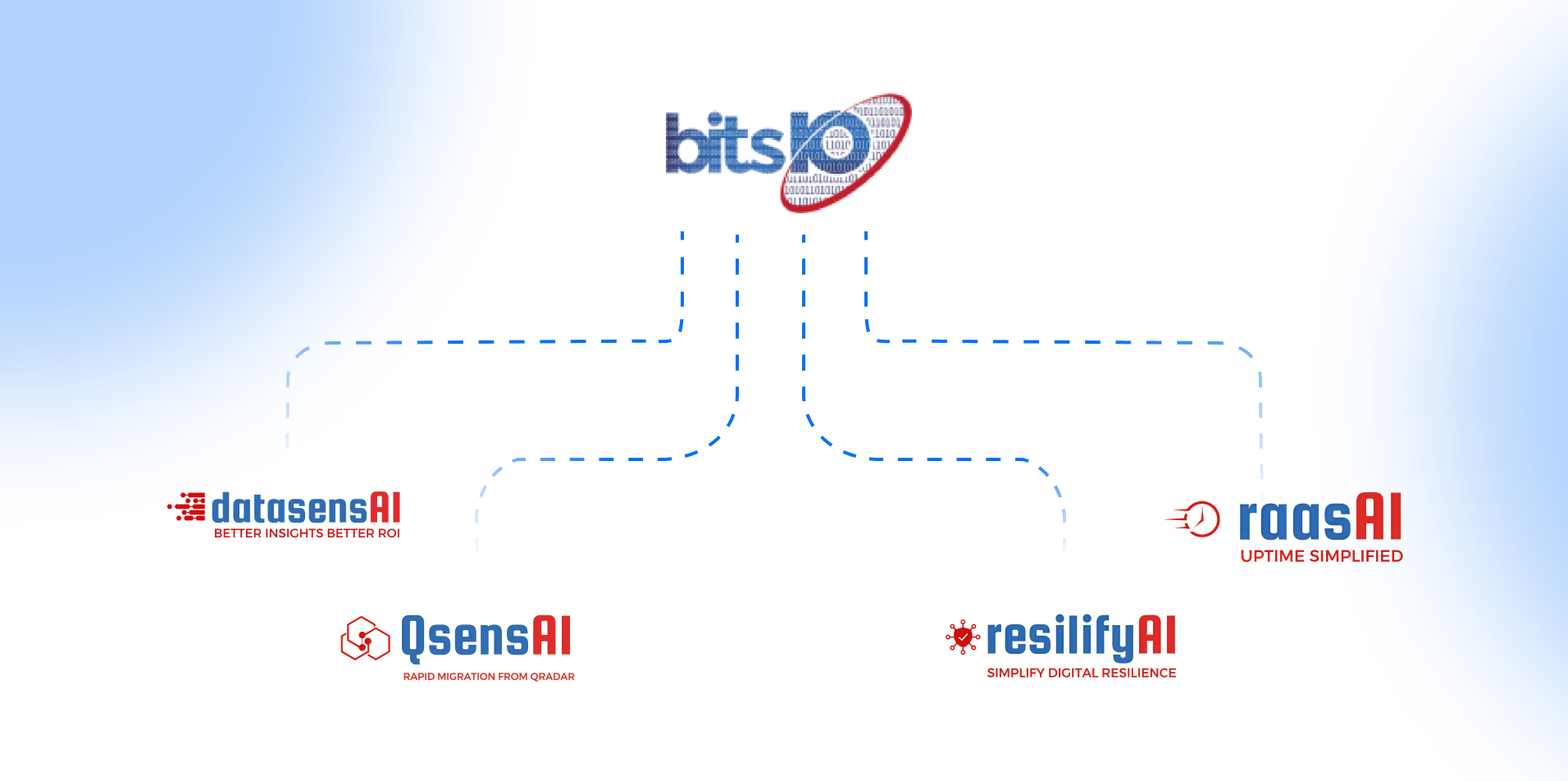
Partner-built AI products extend Splunk into pain points the native platform does not solve. bitsIO publishes four:
datasensAI is an AI-powered Splunk data utilization analyzer. It identifies dormant data sources, calculates ROI per use case, and produces executive dashboards showing where Splunk investment is producing value and where it is not. The published 2-to-4-hour customer time commitment is a deliberate design choice for fast time-to-insight. Most engagements surface 30 to 50 percent recoverable license spend in the first assessment. See the 80% value gap datasensAI closes and datasensAI’s role in Splunk ROI optimization.
QsensAI accelerates QRadar-to-Splunk SIEM migration with AI-driven detection mapping, license estimation, and MITRE ATT&CK alignment. The published 2-to-4-hour customer time commitment for the initial assessment is the same fast-time-to-insight design. The product reduces typical QRadar-to-Splunk migration time from weeks to days. See the QsensAI-accelerated QRadar-to-Splunk methodology.
resilifyAI integrates with Splunk to automate digital resilience: risk management, disaster recovery, and incident response coordination across people, process, and technology dimensions. It addresses the Splunk-adjacent space where IT operations, security operations, and business continuity intersect.
raasAI (Reliability as a Service AI) applies AI and machine learning to IT operations on Splunk. It supports predictive incident detection, automated remediation, and compliance management for IT systems. The product is most effective in environments where Splunk ITSI is already deployed and the goal is to add a predictive and automated layer on top.
Other US partners publish their own AI products and accelerators. TekStream publishes Spyglass as a performance accelerator. Kinney Group publishes the Atlas accelerator suite. The pattern is consistent across mature Splunk partners: proprietary tooling addresses specific pain points the native platform does not solve directly.
Use case 1: AI for Splunk data utilization and ROI
This is the use case with the most consistent ROI evidence across US enterprise Splunk environments. Splunk environments accumulate 30 to 70 percent dormant or low-utilization data over 3 to 5 years. AI-driven analysis of utilization patterns surfaces this waste, prioritizes remediation actions, and produces ongoing visibility into Splunk ROI.
The work is structurally repetitive (run the audit across many sourcetypes, indexes, dashboards) and pattern-rich (the data signatures of dormant data, duplicate indexes, and over-retention are consistent across environments). AI is well-suited to repetitive pattern-matching across structured Splunk metadata. This is what datasensAI automates.
The ROI math is direct. Most environments surface 30 to 50 percent recoverable license spend. For a $1 million annual Splunk license, that translates to $300,000 to $500,000 of recoverable spend identified in 2 to 4 hours of customer time. The work pays for itself before the engagement closes. For deeper detail on this use case, see where the 70–80% of Splunk license waste hides.
Use case 2: AI for SIEM migration
QRadar-to-Splunk migrations have historically been multi-month efforts dominated by manual detection mapping, manual license modeling, and manual app migration. The AI layer changes the time profile.
QsensAI uses AI to map QRadar detection logic to Splunk Enterprise Security correlation searches, align both to MITRE ATT&CK technique coverage, and produce license estimation for the target Splunk environment. The published time reduction is from weeks to days for a typical mid-size QRadar deployment.
The use case extends to other SIEM migrations as IBM continues its 2024 announced strategy direction. For organizations consolidating SIEM platforms in 2026, the migration speed differential is the difference between a 12-week project and a 2 to 3 week project. See the legacy SIEM to Splunk ES 8.4 migration guide for the broader migration context.
Use case 3: AI for notable event correlation
Notable event correlation is the use case Splunk has built directly into the platform via Event iQ. The partner extension is integration with broader SOC workflows, MDR services, and IT operations correlation.
Event iQ proposes correlations the operations team has not manually configured. In environments with mature ITSI deployments, Event iQ surfaces cross-service incidents the team did not know existed: KPI behavior changes that consistently precede outages, alert patterns that turn out to be one root cause, service interactions that the dependency map missed.
The ROI math depends on the size and maturity of the SOC. Environments with high notable event volume (5,000-plus per day) and large analyst teams (10-plus) typically see 30 to 50 percent reduction in analyst triage time once Event iQ is properly deployed. Environments with lower volume see proportionally smaller absolute gains.
For the broader AI-and-SOC context, see why AI is the future of MDR and SOC and how AI-powered MDR accelerates incident response.
Use case 4: AI for predictive IT operations
The predictive IT operations use case is where AIOps and Splunk ITSI intersect. The premise: detect incidents before they impact business, ideally before they generate notable events at all. This is the space raasAI addresses.
The pattern uses machine learning on Splunk-indexed IT operations data to predict incidents from leading indicators (rising error rates, unusual resource consumption, application performance degradation patterns) before they become user-visible outages. When the prediction is high-confidence, automated remediation can fire ahead of the incident. When the prediction is medium-confidence, the operations team gets a heads-up alert with the prediction context attached.
The ROI math depends on the cost of avoided downtime. For environments where unplanned downtime costs $50,000 to $500,000 per hour (typical for customer-facing production systems), one or two predicted-and-prevented incidents per quarter justifies the AI investment. For environments with lower downtime cost or less mature operational telemetry, the math is harder.
Use case 5: AI for digital resilience
Digital resilience as a domain spans risk management, disaster recovery, and incident response coordination across people, process, and technology. resilifyAI is bitsIO’s product in this space. The use case combines compliance management, business continuity, and operational risk into a single AI-augmented platform integrated with Splunk.
The AI value comes from cross-domain pattern recognition: the disaster recovery exercise that surfaces gaps the security team should know about, the compliance audit finding that becomes an IT operations action item, the incident response retrospective that updates the risk register. Most organizations track these domains in separate tools with separate ownership. AI augmentation correlates across them.
The ROI math for digital resilience is harder to compute and longer to realize. It is structurally a hedge against the costs of poor resilience: avoided regulatory penalties, avoided downtime extensions, avoided audit findings, avoided breach response complexity. For organizations in regulated industries (healthcare, financial services, energy), the value tends to compound over time as the resilience program matures.
What to expect from AI for Splunk in late 2026 and beyond
Three trajectories are reasonably well-established for the next 18 months.
Agentic AI inside Splunk. Splunk’s .Conf 2025 keynote signaled investment in agentic AI capabilities (AI systems that take action, not just analyze data). Expect deeper integration of agentic AI into Splunk SOAR playbooks, ITSI episode response, and ES detection workflow.
AI-augmented partner tooling. Partner-built AI products will continue to extend Splunk into specific verticals and workflows the native platform does not address. The most differentiated partners will be the ones with multi-product AI portfolios covering distinct pain points.
AI governance and explainability. Regulated industries (financial services, healthcare, federal) will continue to require explainable AI in production Splunk deployments. Expect formal model risk management workflows to become standard in 2026–2027 procurement requirements.
The honest baseline: AI for Splunk in 2026 is incrementally better than AI for Splunk in 2024, not categorically different. The ROI lives in specific use cases (data utilization, SIEM migration, notable event correlation, predictive IT ops, digital resilience), not in generic “AI on top of Splunk” positioning. Organizations that target specific use cases with AI capability matched to the pain point get the ROI. Organizations that buy generic AI hoping it will improve Splunk get disappointed.
For the partner-selection lens on AI-capable Splunk partners, see the 2026 Splunk Professional Services Partner USA guide.