
Summarize the Content of the Blog





Splunk Security Professional Services are expert-led engagements that deploy, tune, and operate Splunk Enterprise Security (ES) and SOAR to improve how a security operations center detects, investigates, and responds to threats. The work covers ES implementation, correlation search and detection content development, Risk-Based Alerting (RBA), MITRE ATT&CK coverage mapping, SOAR playbook automation, and ongoing tuning to cut alert noise. Done well, these services shorten mean time to detect (MTTD) and mean time to respond (MTTR) while reducing analyst burnout.
The timing matters. Splunk's State of Security 2025 found that 46% of SOC respondents spend more time maintaining tools than defending the organization, and 59% are buried in alerts [1]. A well-configured ES environment fixes both problems. A poorly configured one makes them worse.
Key Takeaways
Splunk Security Professional Services cover ES implementation, detection content development, Risk-Based Alerting, MITRE ATT&CK mapping, SOAR automation, and ongoing tuning.
Risk-Based Alerting groups low-fidelity signals into risk scores, reducing notable volume so analysts focus on real threats instead of chasing false positives.
Splunk ES 8.x introduced agentic AI-powered SecOps across two editions (Essentials and Premier), reshaping how detection and triage work [2].
IBM's 2025 report puts the US average breach cost at a record $10.22 million; organizations with severe security staffing shortages saw costs $1.76 million higher [3].
IDC found organizations using Splunk's unified TDIR platform achieved 304% three-year ROI with 64% faster threat identification [4].
Detection engineering is not a one-time project. Threats evolve, so correlation content needs continuous tuning against MITRE ATT&CK coverage gaps.
What Are Splunk Security Professional Services?
Splunk Security Professional Services are paid engagements where certified consultants build and operate the security side of Splunk: Enterprise Security (the SIEM layer), SOAR (automation and response), and the detection content that ties them together. The goal is a SOC that surfaces real threats quickly and lets analysts act on them without drowning in noise.
This is different from a generic Splunk deployment. Getting logs into Splunk is data onboarding. Turning those logs into accurate, prioritized detections that a SOC analyst can trust is security engineering. The second job is harder and it is where most environments fall short. For the broader platform picture, see What Are Splunk Professional Services?.
You would engage security-focused services for a first-time ES deployment, a SIEM migration onto Splunk, a detection engineering overhaul, RBA implementation, SOAR playbook development, or ongoing SOC content tuning.
What's Included in a Splunk ES Engagement?
A complete Splunk Enterprise Security engagement typically covers six areas.
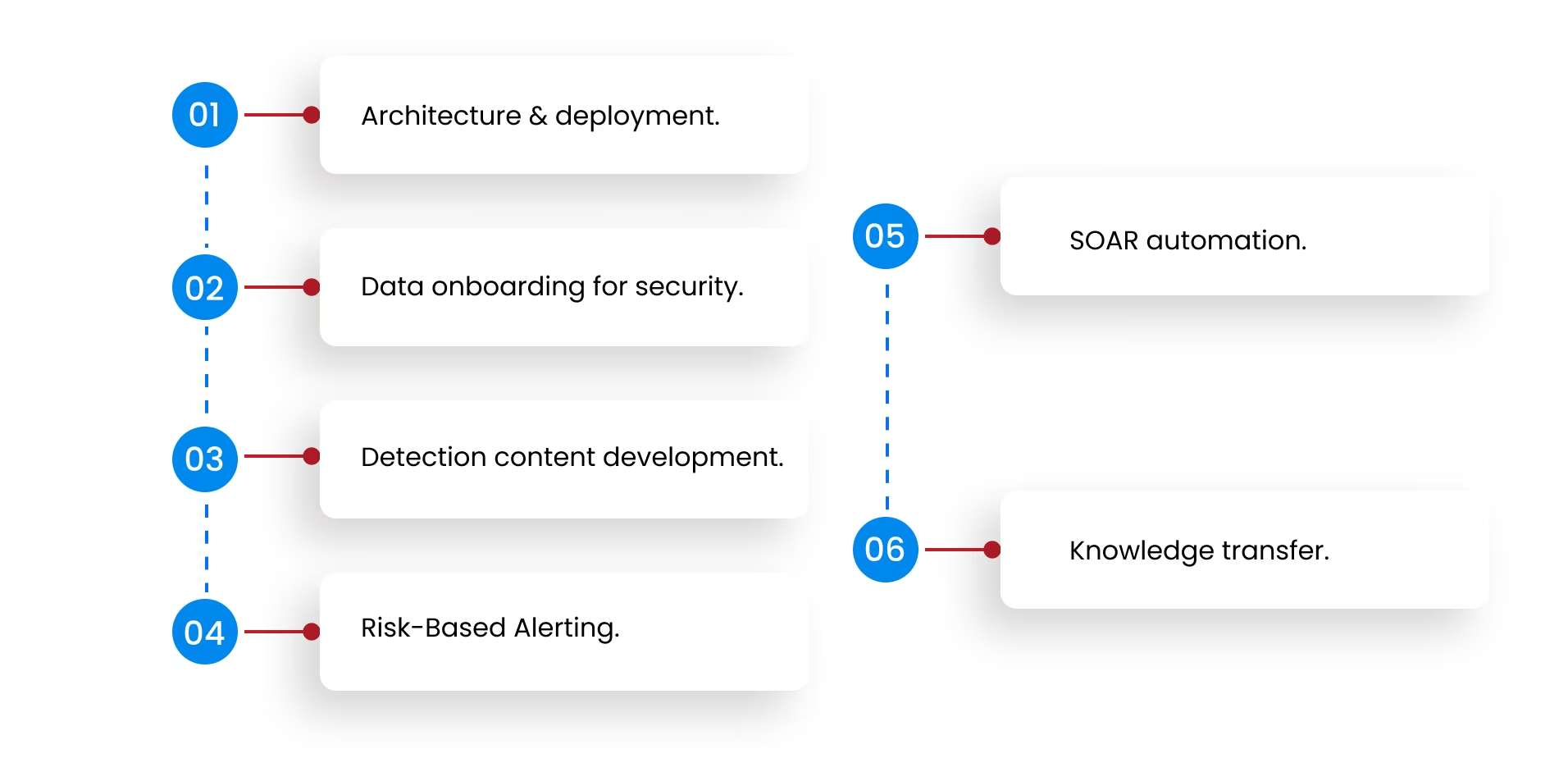
- Architecture and deployment. Sizing the ES deployment, configuring indexes and data models, and validating the Common Information Model (CIM) mapping that ES correlation searches depend on.
- Data onboarding for security. Onboarding the security-relevant sources (endpoint, network, identity, cloud, firewall) and normalizing them to CIM so detections work across data types.
- Detection content development. Building and tuning correlation searches, mapping them to MITRE ATT&CK techniques, and reducing false positives.
- Risk-Based Alerting. Implementing RBA so individual signals contribute to a risk score rather than generating separate notables, cutting alert volume.
- SOAR automation. Developing playbooks for common response actions (enrichment, account lockout, IP blocking) with approval gates for high-risk automations.
- Knowledge transfer. Training your SOC team to author and tune their own detections so the environment does not decay after the engagement ends.
Splunk ES Essentials vs. ES Premier
At .conf25, Cisco introduced two editions of Splunk Enterprise Security, both delivered on ES 8.x with agentic AI-powered SecOps [2]. Understanding the difference helps you scope the right engagement.
The right edition depends on your SOC maturity and compliance needs. A partner should assess your current detection coverage before recommending one, not default to the higher tier.
Risk-Based Alerting: How It Cuts Alert Noise
Risk-Based Alerting is the single most effective change most SOCs can make in Splunk ES. Here is the core idea.
In a traditional setup, every suspicious event generates its own notable. An analyst sees a failed login here, an unusual process there, a data transfer somewhere else, each as a separate alert. Most are benign in isolation, so analysts learn to ignore them. Real attacks hide in that noise.
RBA works differently. Instead of firing a notable per event, it assigns a risk score to each signal and attaches it to a risk object (a user or a host). When a single user or host accumulates enough risk across multiple signals within a time window, ES generates one high-fidelity notable. The analyst sees a prioritized story, not a stream of disconnected alerts.
What good RBA delivers
A well-tuned RBA framework reduces the volume of notables analysts triage while improving the signal quality of what remains. The exact reduction depends on your environment, data quality, and how aggressively the previous rules were configured. The point is not a specific percentage; it is that analysts spend time on threats that matter instead of clearing a queue.
Detection Content Development and Tuning
Detection content is the set of correlation searches, risk rules, and analytics that decide what counts as suspicious. It is the brain of your SIEM, and it needs continuous care.
Mapping to MITRE ATT&CK
MITRE ATT&CK is the industry framework for classifying adversary techniques. A mature detection program maps its correlation searches to ATT&CK techniques, then identifies coverage gaps: which techniques could an attacker use that your current detections would miss? This gap analysis drives the detection roadmap.
Tuning to reduce false positives
Every detection generates some false positives. The tuning process reviews which rules fire most often, whether those alerts are actionable, and how to adjust thresholds or add context so analysts trust the output. Untuned detections train analysts to ignore alerts, which defeats the purpose of the SIEM.
Where datasensAI fits
bitsIO's datasensAI supports this work by providing data scoring, ROI and cost analysis, and MITRE ATT&CK-aligned use-case recommendations, typically 10 to 15 specific use cases per engagement. It helps a SOC see which data sources support meaningful detections and where coverage gaps leave the organization exposed.
The Agentic SOC: What AI Changes in 2026
Splunk's security roadmap under Cisco is moving toward the agentic SOC, where AI handles routine analyst tasks so people focus on strategic decisions. Several capabilities are already available or arriving in 2026.
- Splunk AI Assistant in Security is available across global regions and helps analysts investigate faster using natural language [2].
- Triage Agent, AI Playbook Authoring, Response Importer, and a Personalized Detection SPL Generator are scheduled for 2026, automating parts of detection authoring and response [2].
- Automated Threat Analysis in ES Premier executes attack chain analysis automatically, reducing manual investigation effort [5].
These tools do not replace security engineering judgment. They accelerate it. An agentic SOC still needs well-structured data, tuned detections, and clear response processes underneath the AI layer. That foundation is exactly what Professional Services build. For a deeper look at AI in Splunk operations, see AI-Driven Splunk: How AI Improves Alert Triage and Detection.
How Long Does a Splunk Security Engagement Take?
Timelines depend on scope and data readiness.
The difference between a fast engagement and a slow one is usually data quality and how quickly source-system owners provide access. Clean, CIM-compliant data cuts weeks off the timeline.
How to Choose a Splunk Security Partner
Security work raises the stakes on partner selection. Use these signals, and see the full framework in 9 Questions to Ask Any Splunk Implementation Partner.
- ES-specific certifications. Look for Splunk ES Admin and Splunk Certified Architect on the delivery team, not just core Splunk credentials.
- RBA and detection engineering track record. Ask for sample correlation searches, RBA frameworks, and MITRE ATT&CK coverage examples from real engagements.
- SOAR integration experience. Confirm experience integrating the tools in your stack (ServiceNow, CrowdStrike, Palo Alto, Jira) into SOAR playbooks.
- Compliance depth. For regulated industries, verify experience mapping Splunk detections to HIPAA, PCI DSS, SOX, or FedRAMP requirements.
bitsIO is a four-time Splunk Partner of the Year and Splunk Elite Partner with 300+ enterprise clients, delivering ES implementation, Risk-Based Alerting, detection engineering, and SOAR automation across financial services, healthcare, manufacturing, and public sector.
Frequently Asked Questions