
Summarize the Content of the Blog





Key Takeaways
Splunk Enterprise Security 8.2 introduces an AI-powered SecOps platform that unifies threat detection, investigation, and response (TDIR) in a single seamless experience
AI Assistant for Security embedded directly into workflows enables analysts to generate SPL searches, summarize findings, and accelerate investigations from hours to minutes
Risk-based alerting reduces alert fatigue by aggregating intermediate findings into high-confidence alerts, addressing the challenge of 11,000 daily alerts faced by average SOCs
Detection Studio empowers detection engineers with MITRE ATT&CK-mapped coverage, helping teams discover and deploy high-fidelity detection rules faster
Full-spectrum SOAR integration democratizes automation across the entire SOC, eliminating per-seat constraints for playbook creation and execution
Native UEBA capabilities detect insider threats, compromised accounts, and lateral movement through behavior-based analytics integrated into detection and response workflows
Organizations using Splunk’s unified TDIR platform achieve 64% faster threat identification, 55% faster incident resolution, and 46% reduction in false positive rates
Introduction: The Modern SOC Challenge
Security Operations Centers (SOCs) face an unprecedented challenge in 2025. According to the 2024 SANS SOC Survey, the average SOC handles approximately 11,000 alerts daily, with only 19% worth investigating . This overwhelming volume contributes to what 76% of SOC leaders identify as their top challenge: alert fatigue .
The velocity and sophistication of AI-driven attacks are accelerating faster than ever. Defenders need every possible advantage to overcome today’s and tomorrow’s threats. Traditional Security Information and Event Management (SIEM) solutions that force analysts to swivel between multiple consoles, lose context, and manually hunt for threats are no longer sufficient.
Splunk Enterprise Security 8.2 addresses these critical challenges head-on. Announced at Splunk .conf25, this transformative update represents a fundamental reimagining of how security teams detect, investigate, and respond to threat. By unifying SIEM, SOAR, threat intelligence, and User and Entity Behavior Analytics (UEBA) with embedded AI capabilities into a single intuitive platform, Splunk ES 8.2 empowers every SOC analyst to work faster, smarter, and more effectively.
What’s New in Splunk Enterprise Security 8.2?
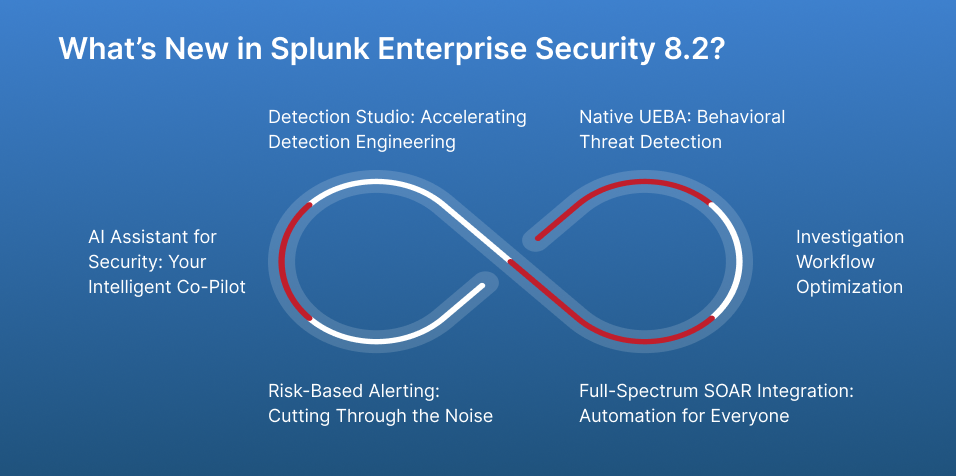
1. AI Assistant for Security: Your Intelligent Co-Pilot
The AI Assistant for Security is embedded directly into Splunk ES 8.2 workflows, transforming how analysts interact with security data . This AI-powered capability addresses one of the most time-consuming aspects of SOC operations: translating security questions into technical queries and synthesizing complex findings.
Key capabilities include:
- Natural language SPL generation: Analysts can generate Search Processing Language (SPL) searches using plain language, eliminating the need for extensive query syntax knowledge
- Automated finding summaries: Quickly summarize individual findings and investigations to accelerate triage and prioritization
- Investigation report generation: Create comprehensive investigation reports automatically, documenting the complete security story
- Next-step recommendations: Receive AI-driven suggestions for investigation paths and response actions
By keeping analysts in control while automating repetitive cognitive tasks, the AI Assistant enables security teams to focus on high-value decision-making rather than manual data manipulation.
2. Risk-Based Alerting: Cutting Through the Noise
One of the most powerful features addressing SOC automation and alert fatigue is risk-based alerting (RBA). This approach fundamentally changes how Splunk ES 8.2 surfaces threats by aggregating multiple low-confidence indicators into single, high-fidelity alerts .
How risk-based alerting works:
Risk-based alerting uses the Splunk Enterprise Security detection framework to collect intermediate findings into a unified risk index. When events in the risk index meet specific criteria—such as crossing risk score thresholds, correlating with MITRE ATT&CK techniques, or involving unique data sources over multiple timeframes—ES 8.2 generates a consolidated finding that warrants investigation .
For example, a single system might generate five separate intermediate findings, each with a low individual risk score. Traditional SIEM approaches would present these as five separate alerts, contributing to alert fatigue. With risk-based alerting, these findings are aggregated based on:
- Combined risk scores exceeding thresholds over 24 hours
- Events from multiple unique data sources over 3 days
- Multiple MITRE ATT&CK tactics observed over 7 days
This correlation creates a single, context-rich finding that tells a complete security story, enabling analysts to detect complex behavior patterns over time rather than isolated point-in-time events .
Business impact: By reducing noise and focusing analyst attention on high-confidence threats, risk-based alerting directly addresses the 46% reduction in false positive rates that organizations achieve with Splunk’s unified TDIR platform .
3. Detection Studio: Accelerating Detection Engineering
Detection Studio (currently in Alpha) represents a significant advancement in how security teams build, test, and deploy detection rules . This capability is designed specifically for detection engineers who need to:
- Discover and deploy high-fidelity detection rules rapidly
- Map detection coverage to the MITRE ATT&CK framework
- Identify and close detection gaps systematically
- Test detection logic before production deployment
Detection Studio integrates seamlessly with Splunk’s detection versioning capabilities, providing an audit trail of when detections are turned on or off, modified, or deployed—including who made changes and when. This is essential for compliance and change management of security rules .
By mapping detections to MITRE ATT&CK tactics and techniques, Detection Studio helps organizations visualize their defensive posture and ensure coverage across the entire attack lifecycle—from initial access through exfiltration and impact .
4. Full-Spectrum SOAR Integration: Automation for Everyone
Perhaps one of the most democratizing features in Splunk ES 8.2 is the full-spectrum SOAR integration available in ES Premier edition. Unlike traditional SOAR solutions that impose per-seat licensing constraints, Splunk ES 8.2 makes automation and playbook capabilities available to every analyst in the SOC .
Key SOAR capabilities include:
- Embedded automation: Run actions and playbooks directly within investigation workflows
- Playbook creation and editing: Security teams can standardize response procedures through customizable playbooks
- SOAR pairing: Native integration with both Splunk SOAR (Cloud) and on-premises Splunk SOAR instances
- Prompt-based workflows: Analysts can respond to checkpoints in automated workflows, keeping humans in control of critical decisions
This integration eliminates the need to context-switch between separate SOAR consoles, enabling analysts to execute automated response actions without leaving their investigation workspace .
Practical example: When investigating a phishing incident, an analyst can trigger an automated playbook that simultaneously quarantines the affected endpoint, blocks malicious email senders, and enriches threat indicators—all from within the investigation interface.
5. Native UEBA: Behavioral Threat Detection
User and Entity Behavior Analytics (UEBA), available in ES Premier, brings advanced behavioral detection capabilities directly into Splunk Enterprise Security 8.2 . Unlike traditional signature-based detection, UEBA establishes baseline behavior patterns for users and entities, then identifies anomalous activities that may indicate compromise.
UEBA in ES 8.2 detects:
- Insider threats: Unusual access patterns, data exfiltration attempts, or privilege abuse by authorized users
- Compromised accounts: Login anomalies, impossible travel scenarios, or unusual authentication patterns
- Lateral movement: Abnormal network traversal or system access that suggests an attacker moving through the environment
By integrating UEBA findings directly into the unified risk index, these behavioral signals contribute to risk-based alerting and investigation workflows, providing analysts with comprehensive context about user and entity behavior alongside traditional security events .
6. Investigation Workflow Optimization
Splunk ES 8.2 introduces multiple enhancements designed to streamline investigation workflow efficiency:
- Unified analyst queue: A redesigned interface that consolidates findings, investigations, and finding groups with improved filtering and auto-refresh capabilities
- Finding groups with lookback and overlap: Create groups of related findings based on historical patterns or overlapping conditions to prevent overlooking edge cases
- Sync changes across included findings: Apply status updates, severity changes, or other modifications to all findings within an investigation simultaneously
- Enhanced note collaboration: View notes on findings or finding groups included in investigations for complete context
- Configurable finding group behavior: Control whether closed finding groups should reopen when new findings are added
These workflow improvements reduce the cognitive load on analysts and ensure that related security events are investigated holistically rather than in isolation.
The Business Value: Proven Results from Real Organizations
The capabilities in Splunk Enterprise Security 8.2 aren’t just feature enhancements—they deliver measurable business outcomes. According to an independent IDC study titled “The Business Value of Splunk Security: A Unified TDIR Platform,” organizations using Splunk’s unified approach achieve significant operational and financial benefits :
Operational Improvements:
- 64% faster threat identification: Accelerated detection reduces attacker dwell time
- 55% faster incident resolution: Streamlined investigation workflows speed response
- 46% reduction in false positive rates: Risk-based alerting cuts through noise
- 111% more threats identified: Enhanced detection capabilities surface previously missed threats
Financial Impact:
- 304% ROI: Substantial return on SIEM and SOAR investment
- 12-month payback period: Rapid value realization
- 38% cost reduction: Compared to equivalent security solutions
- $4.89M in annual savings: From consolidating tools and automating security operations
These results demonstrate that the unified TDIR platform approach—combining SIEM, SOAR, UEBA, and AI in a single workflow—delivers both operational excellence and financial value.
Industry Recognition
Splunk’s leadership in Security Information and Event Management continues to earn analyst recognition:
- Gartner Critical Capabilities for SIEM 2024: Ranked #1 SIEM in all three Use Cases for the second consecutive year
- Gartner Magic Quadrant for SIEM 2025: Named a Leader for the 11th consecutive time
- IDC Worldwide SIEM Market Shares 2023: Ranked #1 for the fourth consecutive year
This consistent recognition validates Splunk’s innovation in AI-powered threat detection, SOC automation, and unified security operations.
Splunk ES 8.2 Editions: Essentials vs. Premier
To meet diverse organizational needs, Splunk Enterprise Security 8.2 is available in two editions :
Splunk ES Essentials
Delivers the industry-leading SIEM experience with:
- Unified TDIR interface and workflows
- AI Assistant for Security
- Detection Studio (where available)
- Risk-based alerting capabilities
- Core threat detection and investigation features
Ideal for: Organizations building or modernizing their SOC capabilities with a strong foundation for future growth.
Splunk ES Premier
Converges the full spectrum of advanced capabilities:
- Everything in Essentials, plus:
- Native UEBA for behavioral threat detection
- Full-spectrum SOAR with unlimited automation
- Advanced detection and response automation
- Comprehensive threat intelligence integration
Ideal for: Enterprise SOCs requiring advanced automation, behavioral analytics, and end-to-end threat lifecycle management.
Both editions share the same trusted ES foundation and intuitive interface, ensuring analysts benefit from a consistent experience regardless of edition .
How bitsIO Can Help: Your Trusted Splunk Implementation Partner
Implementing Splunk Enterprise Security 8.2 successfully requires more than just software installation—it demands deep expertise in security operations, data architecture, and use case development. As a 4x Splunk Partner of the Year, bitsIO brings proven experience helping organizations maximize their Splunk ES investments .
bitsIO’s Splunk ES Services:
1. Strategic Implementation
- End-to-end Splunk ES 8.2 deployment tailored to your security requirements
- Architecture design for on-premises, cloud, or hybrid environments
- Migration planning from legacy SIEM platforms or earlier ES versions
- Integration with existing security tools and data sources
2. Use Case Development
Our certified consultants develop custom detection and response use cases aligned to your threat model:
- Risk-based alerting configuration for your environment
- Custom correlation searches mapped to MITRE ATT&CK
- SOAR playbook development for automated response workflows
- UEBA model tuning for behavioral detection accuracy
3. Detection Engineering Excellence
- Detection Studio implementation and workflow optimization
- Detection coverage assessment against MITRE ATT&CK framework
- Detection versioning and audit trail configuration
- Testing and validation frameworks for detection rules
4. AI Assistant Optimization
- AI Assistant enablement and configuration
- Training for analysts on AI-powered investigation workflows
- Custom SPL template development for common investigation patterns
- Integration of AI recommendations into SOC procedures
5. Compliance and Reporting Accelerators
bitsIO helps organizations meet regulatory mandates including:
- PCI-DSS security monitoring requirements
- HIPAA audit and compliance reporting
- SOX IT controls and change management
- Custom compliance dashboards and alert configurations
6. Managed Services and Support
- Co-managed SOC services: Augment your team with bitsIO’s security experts
- Fully managed SIEM: Complete operational management of your ES environment
- 24/7 monitoring and response: Around-the-clock threat detection and incident response
- Health checks and optimization: Regular assessments to ensure peak performance
The bitsIO Advantage:
With 300+ enterprise clients across financial services, healthcare, education, retail, and technology sectors, bitsIO has refined proven methodologies for Splunk ES success. Our 50+ certified consultants bring specialized expertise in :
- Security architecture and threat modeling
- Data onboarding and normalization
- Custom integration development
- Performance tuning and optimization
- Training and knowledge transfer
Whether you’re implementing ES 8.2 for the first time, upgrading from earlier versions, or optimizing an existing deployment, bitsIO ensures you extract maximum value from your Security Information and Event Management investment.
Ready to Optimize Your Splunk ROI?
Many organizations underutilize 70-80% of their security data, missing critical opportunities for threat detection and operational efficiency. bitsIO’s datasensAI approach helps identify optimization opportunities through AI-driven analysis of your Splunk environment, uncovering hidden value in dormant data sources .
Conclusion: The Future of Security Operations Starts Now
Splunk Enterprise Security 8.2 represents a paradigm shift in how security teams operate. By unifying SIEM, SOAR, UEBA, and threat intelligence with embedded AI capabilities, Splunk has created a platform that addresses the fundamental challenges facing modern SOCs: alert fatigue, context switching, and analyst burnout.
The numbers speak for themselves: 64% faster threat identification, 55% faster incident resolution, and 304% ROI demonstrate that AI-powered threat detection and SOC automation aren’t just buzzwords—they’re delivering measurable business outcomes .
For detection engineers, the combination of Detection Studio and MITRE ATT&CK mapping provides unprecedented visibility into defensive coverage. For analysts, the AI Assistant and risk-based alerting cut through noise and accelerate investigations. For SOC managers, the unified TDIR platform reduces tool sprawl and improves team productivity.
Organizations that embrace these capabilities—particularly when partnering with experienced implementation specialists like bitsIO—position themselves to stay ahead of evolving threats while optimizing their security operations investments.
The question isn’t whether to adopt AI-powered SIEM and unified SOC management tools—it’s how quickly you can implement them to protect your organization in an increasingly hostile threat landscape.
Ready to transform your SOC with Splunk Enterprise Security 8.2? bitsIO’s expert team is prepared to guide your journey from assessment through implementation and ongoing optimization.
Book a Consultation with bitsIO Today
Discover how Splunk ES 8.2’s advanced capabilities can reduce your threat detection and response times while empowering your security team with AI-driven insights.
Frequently Asked Questions (FAQs)