
Summarize the Content of the Blog





Key Takeaways
70-80% of enterprisedata remains underutilized, representing massive wasted investment in storage,processing, and licensing costs.
datasensAI’s AI-driven scoringalgorithm transforms abstract data utilization into actionable metrics,enabling data-driven resource allocation decisions.
ROI visibility through cost allocationanalysis empowers mid-size enterprises to reallocate licenses, eliminate waste,and justify strategic expansions.
Four-step implementation frameworkdelivers actionable insights in days with only 2-4 hours of initial assessmenttime.
The numbers tell a sobering story: Organizations invest heavily in Splunk infrastructure, yet 70-80% of their data remains untapped—dormant, underutilized, and generating zero business value. For mid-size enterprises navigating cloud migrations, security threats, and operational complexity, this isn’t just wasted potential—it’s wasted capital, missed insights, and competitive disadvantage.
According to Gartner, organizations waste an average of $12.9 million annually on unused or underutilized software , with data analytics platforms representing a significant portion of this waste. Meanwhile, IDC research reveals that companies utilize only 32% of the data available to them , leaving the majority of their information assets dormant despite substantial investment in collection and storage infrastructure.
The culprit? A decision gap that plagues modern data operations. Teams know they have data. They know it’s valuable. But they lack the visibility, actionable intelligence, and automated workflows to transform raw observability into strategic outcomes. Traditional Splunk deployments excel at data ingestion but falter at data activation, leaving organizations paying premium licensing fees while their most valuable insights remain buried in unused indexes and forgotten dashboards.
This is where datasensAI, a Splunk-certified app developed by bitsIO—a trusted global Splunk partner—fundamentally changes the equation. By providing data scoring, ROI analysis, and AI-driven use case recommendations, datasensAI doesn't just optimize your existing investment; it unlocks an entirely new dimension of value that most organizations never knew existed.
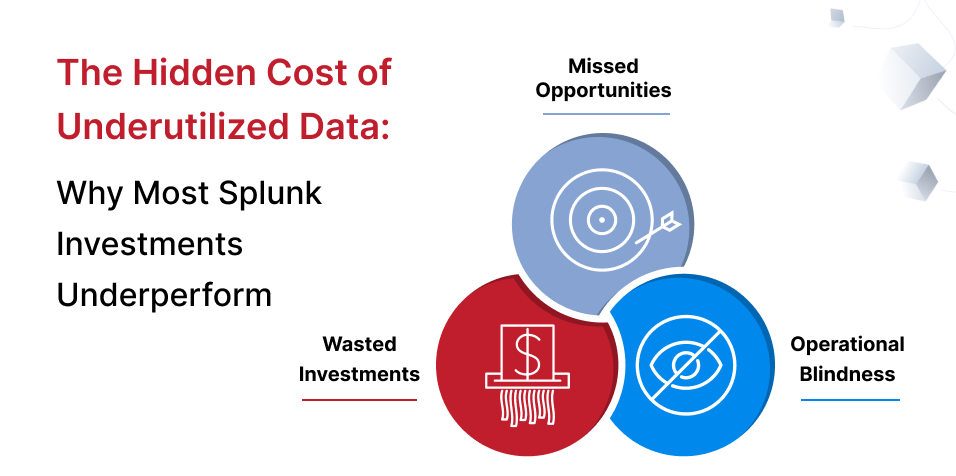
Before exploring solutions, let’sacknowledge the uncomfortable reality facing most Splunk administrators and data strategyleaders.
Three Critical Pain Points:
1. Wasted Investments
Your organization is paying for dataingestion, storage, and processing—but extracting minimal value. Every unuseddata source, abandoned dashboard, and dormant alert represents sunk costwithout a corresponding return. Research from NewVantage Partners indicatesthat 92% of organizations are not achieving their desired outcomes from dataand AI investments , primarily due to utilization challenges rather thantechnology limitations.
2. Missed Opportunities
That underutilized security log? It could reveal breach patterns. Those unused application metrics? They might predict performance bottlenecks before customers notice. Without visibility into what’s not being used, you can’t capitalize on what could be. According to IBM, the average cost of a data breach reached $4.45 million in 2023 with many breaches involving indicators that were present in logs but never analyzed due to insufficient monitoring coverage.
3. Operational Blindness
Most teams lack clear metrics on datautilization, ROI analysis, or performance benchmarking across data sources.Without a scoring mechanism to measure “data mileage,” decision-makers operateon intuition rather than intelligence. Forrester research shows that 60-73% ofall enterprise data goes unused for analytics, representing a massiveopportunity cost.
The result? Organizations continue expanding their Splunk footprint—adding licenses, scaling infrastructure, increasing costs—without ever maximizing the assets they already own.
How datasensAI Closes the Decision Gap: From Data Scoring toStrategic Action
datasensAI eliminates the guesswork byintroducing a data scoring algorithm that transforms abstract utilization intoconcrete, actionable metrics.
The Data Scoring Methodology
At its core, datasensAI assigns each datasource a utilization score based on knowledge object creation and usagepatterns:
- High-Score Data Sources: Actively leveraged through dashboards, reports, alerts, data models, and ad-hoc searches
- Low-Score Data Sources: Ingested but underutilized—prime candidates for new use casedevelopment or license reallocation
This scoring mechanism evaluates:
- Dashboard creation and interactionfrequency
- Saved search and report generation
- Alert configuration and triggerrates
- Data model utilization foraccelerated analytics
- Ad-hoc search patterns revealingorganic exploration
Why This Matters: The score isn’t just a vanity metric—it’s a decision engine that guides resource allocation, identifies optimization opportunities, and quantifies ROI with unprecedented precision. Studies show that organizations with mature data governance and utilization metrics achieve 5-6% higher productivity than their peers .
AI-Driven Analysis & Reporting
Once data sources are scored,datasensAI’s AI use case recommender analyzes patterns,identifies inefficiencies, and generates comprehensive reports with actionableinsights aligned to industry frameworks like MITRE ATT&CK.
- For underutilized data sources,datasensAI doesn’t just identify the gap—it prescribes specific use casestailored to your environment:
- Security monitoring templates forcompliance (GDPR, HIPAA, PCI-DSS)
- Performance optimization dashboards forapplication teams
- Cost allocation models for FinOpsinitiatives
- Predictive maintenance alerts forinfrastructure reliability
This transforms data observability fromreactive monitoring to proactive intelligence, where AI continuously surfacesopportunities you didn’t know to look for. McKinsey research indicates that AI-augmented analytics can improveoperational efficiency by 20-30% when properly implemented.
Maximizing Splunk ROI: The 80%More Value Promise
Let’s translate capability into tangiblebusiness outcomes. How does datasensAI deliver 80% more value from existingSplunk investments?
ROI Visibility Through CostAllocation Analysis
datasensAI provides granular breakdownsof:
- Data storage costs per source
- Processing overhead by data type
- License utilization efficiency acrossteams
- Cost-per-insight ratios forknowledge objects
Armed with this intelligence,organizations can:
- Reallocate licenses fromlow-performing teams to high-value use cases
- Eliminate waste by decommissioningunused data sources or renegotiating retention policies
- Justify expansion with data-drivenbusiness cases tied to measurable outcomes
According to Nucleus Research, analytics solutions deliver an average ROIof $13.01 for every dollar spent [8], but only when properly optimized andactively utilized—highlighting the critical importance of utilizationvisibility.
Take Action: Transform Your Splunk Investment Today
The decision gap between dataavailability and data action doesn’t close itself. It requires intentionalstrategy, intelligent tooling, and expert partnership.
datasensAI by bitsIOoffers:
- Rapid 2-4 hour assessment withzero external access required
- AI-powered analysis deliveringactionable insights in days
- Automated use case implementationfor top-10 underutilized data sources
- Ongoing optimization and expertsupport from certified Splunk professionals
- Measurable ROI through costallocation, license optimization, and productivity gains
Whether you’re struggling withunderutilized data, facing budget pressure to justify Splunk costs, or simplywant to maximize the value of your observability investment, datasensAIprovides the clarity and automation to transform potential into performance.
Ready to unlock 80% more value from your Splunk deployment?
Booka consultation with bitsIO and discover how datasensAI can closeyour decision gap, automate your monitoring, and transform your data intostrategic advantage.