
Summarize the Content of the Blog





Key Takeaways
Alert fatigue is reaching crisis levels: 56% of security teams feel overwhelmed by daily alerts, with false positive rates as high as 70%
Predictive analytics is the game changer: Splunk ITSI can predict incidents up to 30 minutes in advance, transforming reactive operations into proactive strategies
Dramatic operational improvements are achievable: Organizations report up to 95% reduction in alert noise and 90% reduction in MTTR
AI-driven incident management is becoming essential: By 2026, 30% of enterprises will automate more than half of their network activities
Integration capabilities drive success: Seamless connectivity between Splunk ITSI and existing ITSM tools creates unified, efficient workflows
The market is exploding: The Predictive analytics market is growing at 21.8% CAGR, making early adoption a competitive advantage
The Alert Fatigue Crisis: A Modern IT Operations Challenge
In 2026, IT operations teams face an unprecedented challenge that's quietly undermining their effectiveness: alert fatigue. What started as a productivity issue has evolved into a security and operational threat that's costing organizations millions in downtime, security breaches, and lost productivity.
The statistics paint a sobering picture. A recent industry survey revealed that 56% of security teams feel overwhelmed by incoming alerts on a daily or weekly basis . Even more concerning, some organizations report false alarm rates as high as 70%, creating a dangerous scenario where critical incidents can be buried under an avalanche of meaningless notifications.
This isn't just about too many alerts—it's about the fundamental breakdown of traditional monitoring approaches. Modern enterprises deploy dozens of monitoring tools across networks, endpoints, cloud services, and applications. Each tool generates its own alerts, creating overlapping, conflicting, or incomplete signals that force analysts to manually reconcile data across disconnected systems.
The human cost is significant. When analysts face thousands of alerts daily, most of which go uninvestigated, they become desensitized to warnings. This creates dangerous blind spots where real threats slip through unnoticed. The business impact is equally severe: the average data breach now costs organizations over $4.4 million globally, with each day of delayed detection adding to the damage.
The Alert Fatigue Problem: Beyond Human Limitations
The scale of modern IT environments has simply outpaced human capacity to process and respond to alerts effectively. Consider the numbers: organizations now handle hybrid cloud infrastructures spanning on-premises data centers, multiple cloud providers, and edge computing environments. Each component generates telemetry data at unprecedented volumes.
Traditional monitoring approaches treat each system in isolation. Network monitoring tools alert on connectivity issues, application performance monitoring focuses on response times, and security tools flag potential threats. The result is a cacophony of disconnected alerts that require extensive manual correlation to understand the real business impact.
Mean Time to Resolution (MTTR) remains the most popular performance indicator, used by 86% of organizations , yet traditional approaches consistently fail to improve this critical metric. Why? Because siloed tools create information gaps that slow down investigation and resolution processes.
The problem compounds in hybrid application monitoring scenarios. As applications span multiple environments—containerized microservices in the cloud, legacy systems on-premises, and API integrations with third-party services—tracking service health becomes exponentially complex.
Teams struggle to answer fundamental questions: Which components are truly critical to business services? How do infrastructure issues impact customer-facing applications? What patterns predict service degradation?
Why Splunk ITSI is a Game Changer
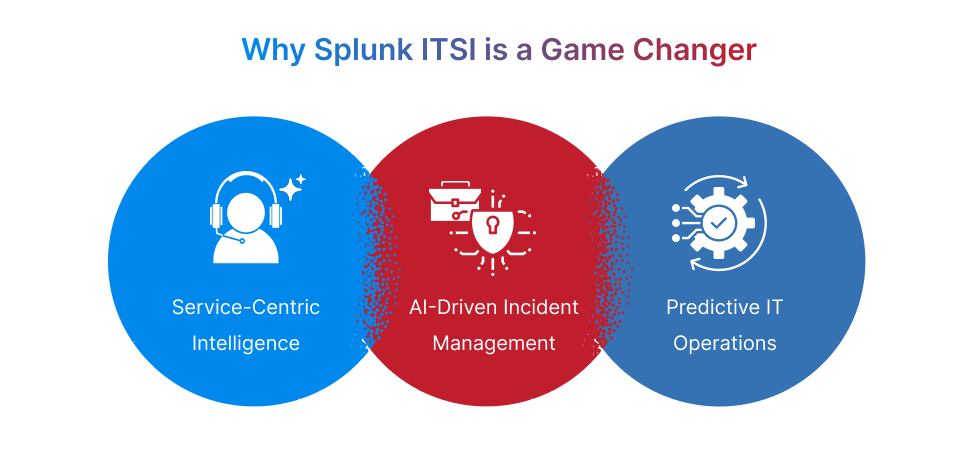
Splunk IT Service Intelligence (ITSI) representsa fundamental shift from reactive monitoring to proactive IT operations. Unliketraditional tools that focus on individual system metrics, ITSI takes aservice-centric approach that aligns technical operations with businessoutcomes.
Service-Centric Intelligence
ITSI transforms rawtelemetry data into business-relevant insights through its service modelingcapabilities. Instead of monitoring hundreds of individual components, teamsdefine services that represent actual business functions—customer checkoutprocesses, payment systems, or user authentication workflows. This approachimmediately clarifies which alerts matter most to the business.
The platform's KPI-basedservice health scoring provides real-time visibility into serviceperformance. Rather than tracking countless individual metrics, teams monitorcomposite health scores that reflect the true impact on business operations.When a service health score drops, teams immediately understand the businesscontext and can prioritize their response accordingly.
AI-Driven Incident Management
ITSI's machine learningcapabilities address the alert fatigue crisis head-on. The platform's Splunkincident correlation AI automatically groups related events into episodes,dramatically reducing the noise that overwhelms operations teams. Instead ofreceiving dozens of related alerts, teams get a single, contextually richepisode that includes all relevant information.
The system learns normalbehavior patterns across all monitored services and can identify anomalies thattraditional threshold-based alerting would miss. This means teams catch subtledegradations before they impact customers, while avoiding false positives thatwaste valuable time.
Predictive IT Operations
Perhaps most importantly,ITSI moves organizations from reactive to predictive IT operations. Theplatform analyzes historical patterns, current trends, and real-time data toforecast potential issues before they occur. This predictive capabilitytransforms how teams think about incident management—from fighting fires topreventing them.
PredictiveAnalytics: The Future is Now
The predictiveanalytics market is experiencing explosive growth, with a compound annualgrowth rate of 21.8% expected through 2033. This growth reflects thecritical need for organizations to move beyond reactive approaches to IToperations management.
Machine Learning-Powered Predictions
Splunk ITSI's predictive analyticscapabilities leverage advanced machine learning algorithms to analyze vastamounts of historical and real-time data. The system identifies subtle patternsand correlations that human analysts would miss, enabling incidentprediction up to 30 minutes in advance .
This advance warningtransforms incident response. Instead of scrambling to understand what wentwrong after systems fail, teams receive actionable intelligence about potentialissues while there's still time to intervene. The result is a dramaticreduction in customer-impacting incidents and improved service reliability.
Adaptive Thresholding Intelligence
Traditional alertingrelies on static thresholds that quickly become outdated as systems evolve.
ITSI's adaptivethresholding continuously learns normal behavior patterns for each service andautomatically adjusts alerting thresholds based on historical data, seasonalpatterns, and trending changes.
This dynamic approacheliminates many false positives while ensuring that genuine anomalies triggerappropriate responses. Teams spend less time investigating meaningless alertsand more time on activities that truly impact business outcomes.
Root Cause Analysis Automation
Whenincidents do occur, ITSI's root cause analysis automation acceleratesinvestigation and resolution. The platform automatically correlates symptomsacross multiple systems, identifying the underlying cause of service degradation.This correlation happens in seconds rather than the hours typically requiredfor manual investigation.
The system presentsinvestigation results through intuitive visualizations that show therelationships between affected services, supporting infrastructure, andpotential root causes. This contextual intelligence enables faster, moreaccurate problem resolution.
Real-World Impact: How Organizations Are Winning
The theoretical benefits of predictiveanalytics and intelligent incident management become real when implementedeffectively. Through our work at bitsIO, we've witnessed firsthand howorganizations across various industries have transformed their operations usingSplunk ITSI.
Why bitsIO? Your Trusted Splunk ITSIPartner
As a 3xSplunk Partner of the Year, bitsIO brings unmatched expertise indeploying, tuning, and managing Splunk ITSI environments. Our team's deeptechnical knowledge, combined with proven implementation methodologies, ensuresorganizations achieve maximum value from their ITSI investment faster and withless risk.
Comprehensive ITSI Expertise
Service Modeling and Use Cases:Our experts work closely with your teams to definebusiness-aligned services, establish meaningful health scores, and createtailored service level use cases that reflect real business priorities.
Predictive Analytics andEpisode Tuning: We configure and fine-tune episodereview processes, anomaly detection algorithms, and forecasting capabilities tosurface true service degradation early while minimizing false positives.
Workflow and ITSM Integration: Our integration specialists automateticketing, on-call handoffs, and remediation processes directly from the ITSIcontext, creating seamless workflows that accelerate incident response.
Custom Dashboards andEnablement: We deliver purpose-built visualizationsolutions and provide comprehensive training to ensureyour teams can leverage ITSI's full capabilities from day one.
Flexible Deployment and Support Options
Deployment Flexibility: Whether you need on-premises, cloud, or hybrid deployments, our teamoptimizes performance while meeting your specific infrastructure requirementsand compliance needs.
Engagement Models: Choose from rapid capability assessments, proof-of-concept validation,or comprehensive long-term implementation support based on your organizationalneeds and timeline.
Co-Managed and Fully ManagedSupport: Select collaborative co-management orcomprehensive fully managed solutions based on your internal capabilities andstrategic objectives.
Continuous Optimization and Compliance
- Health Checks and ServiceRe-tiering: Regular system health assessments ensureyour ITSI deployment continues to deliver optimal value as your infrastructureevolves.
- Compliance Reporting: Built-in auditing and reporting capabilities help organizationsdemonstrate compliance with standards such as PCI-DSS, HIPAA, and SOX.
- Continuous Improvement: We embed feedback loops, service level monitoring, and maturityevolution using AIOps to keep your observability aligned with changing businesspriorities.
Proven Track Record
Ourclient testimonials speak to the quality of our delivery and partnershipapproach. As one senior fintech leader noted: "I wholeheartedlyrecommend engaging with bitsIO based on my firsthand experience of theirremarkable ease of doing business, unwavering commitment to deliveringtop-notch work, and genuine care in ensuring their efforts directly contributeto our shared success."
The results speak for themselves:
- 60% reduction in unplanned downtime
- 95% reduction in alert noise
- 90% reduction in MTTR
- 45% reduction in total incidents
- 30-minute advance incident prediction
IntegrationBest Practices for Splunk ITSI and Observability Cloud
Successfully integrating SplunkITSI with Splunk Observability Cloud requiresstrategic planning and adherence to proven best practices. The integrationcreates a powerful ecosystem that combines ITSI's service-centric intelligencewith Observability Cloud's deep application and infrastructure monitoringcapabilities.
Architectural Considerations
- Data Flow Optimization: Establish efficient data pipelines that minimize latency betweenObservability Cloud telemetry collection and ITSI service analysis. Thisrequires careful consideration of data routing, indexing strategies, andnetwork connectivity between components.
- Service Mapping Alignment: Ensure service definitions in ITSI accurately reflect the applicationtopology discovered by Splunk APM and infrastructure monitoring. Thisalignment prevents gaps in observability and ensures incidents are properlycorrelated across the entire service delivery chain.
- Hybrid Cloud MonitoringIntegration: For organizations operating hybrid application monitoring environments, establishconsistent data collection standards across on-premises and cloud-nativecomponents. This standardization enables ITSI to provide unified service healthscoring regardless of where components are hosted.
Data Correlation Strategies
- Unified Tagging Standards: Implement consistent tagging strategies across all monitoredcomponents. Tags should include business service identifiers, environmentclassifications, and ownership information that enable ITSI to automaticallycorrelate events across different monitoring domains.
- Metric Standardization: Establish common metric naming conventions and measurement units acrossSplunk Observability components. This standardization enables moreaccurate KPI health scores and reduces confusion during incidentinvestigation.
- Event Enrichment: Configure event enrichment processes that add business context totechnical telemetry data. This enrichment enables ITSI's AI-driven incident management capabilitiesto make more intelligent decisions about alert prioritization and correlation.
Performance Optimization
- Threshold Tuning: Regularly review and adjust alerting thresholds based on servicebehavior patterns observed through integrated monitoring. ObservabilityCloud troubleshooting insights should inform ITSI threshold optimization toreduce false positives.
- Resource Allocation: Monitor resource utilization across both ITSI and Observability Cloudcomponents to ensure optimal performance. This includes CPU, memory, andstorage requirements for data processing and retention.
- Network Optimization: For hybrid cloud monitoring deployments, optimize networkconnectivity between monitoring components and ensure adequate bandwidth fortelemetry data transmission.
Conclusion: The Path Forward
The transformation fromalert chaos to predictive clarity represents more than a technologyupgrade—it's a fundamental shift in how organizations approach IT operations.As we've seen through real-world case studies and industry data, Splunk ITService Intelligence provides the foundation for this transformation,delivering measurable improvements in operational efficiency, servicereliability, and business outcomes.
The evidence iscompelling: organizations implementing ITSI achieve 95% reductions in alertnoise and 90% reductions in MTTR, while gaining the ability to predictincidents up to 30 minutes in advance. These improvements translate directly tobetter customer experiences, reduced operational costs, and improved businessresilience.
The market momentumsupports early adoption. With the predictive analytics market growing at21.8% CAGR [6] and 30% of enterprises automating more than half of theirnetwork activities by 2026, organizations that delay thistransformation risk falling behind competitors who embrace proactive, AI-drivenoperations.
Success in thistransformation requires more than technology—it requires the right partnership.bitsIO's proven track record as a 3x Splunk Partner of the Year demonstratesour commitment to delivering measurable outcomes for our clients. Our SME-lessdeployment capabilities, comprehensive integration expertise, and ongoingoptimization support ensure your ITSI investment delivers maximum value fromday one.
The path forward isclear: embrace predictive IT operations, leverage AI-driven incidentmanagement, and partner with experts who understand both the technology andthe business outcomes you need to achieve. The future of IT operations ispredictive, proactive, and intelligent—and that future is available today.
Ready to Transform Your IncidentManagement?
Don't let alert fatigueundermine your IT operations' effectiveness. Join the growing number oforganizations that have transformed their incident management capabilities withSplunk IT Service Intelligence and bitsIO's expert implementationservices.
Contact bitsIO today to discover how predictive analytics and AI-driven incident managementcan revolutionize your operations:
Book a Consultation
Our team of Splunkexperts is ready to help you achieve the same dramatic improvements our clientshave experienced: 95% reduction in alert noise, 90% reduction in MTTR, and30-minute advance incident prediction. The future of IT operations ispredictive—let us help you get there.