
Summarize the Content of the Blog





Key takeaways
SOAR is orchestration, playbook automation, and case management in one platform . It coordinates your existing tools rather than replacing them.
Splunk's own guidance is blunt: SOAR is not a replacement for a SIEM, and not a replacement for a well-designed SOC and experienced analysts. Read that before you buy.
The ROI comes from automating high-volume, repeatable, low-judgment work. Automating rare or high-judgment work is where SOAR projects stall.
The best use of SOAR is to send it only events that need work done. Pointing all your alerts at it is a common and expensive mistake.
SOAR does not eliminate analysts. It removes the mechanical toil around their decisions, so their time goes to judgment instead of copy-paste.
1. What Splunk SOAR actually is
Splunk SOAR (Security Orchestration, Automation, and Response) is a platform that combines security infrastructure orchestration, playbook automation, and case management to integrate your team, processes, and tools, so you can orchestrate security workflows, automate repetitive security tasks, and respond to threats faster .
Strip the acronym expansion and it means this: SOAR is the layer that makes your security tools work together and takes the repetitive human steps out of responding to an alert. When a phishing report arrives, instead of an analyst manually pulling the email, checking the sender reputation, detonating the attachment, and searching for other recipients, a SOAR playbook does those steps and hands the analyst a decision.
One thing to be clear about from the start, because it shapes every ROI conversation: SOAR orchestrates your existing stack rather than replacing it. Splunk's SOAR catalog integrates across hundreds of third-party tools and supports thousands of automated actions, so the point is coordination, not rip-and-replace . You are not buying a new security tool. You are buying the connective tissue between the ones you have.
2. What SOAR does: orchestration, automation, case management
Three capabilities, and understanding the split is enough to make a buying decision.
Orchestration connects your tools so an action in one triggers an action in another. SOAR coordinates workflows across your security and IT stack so each tool plays a part in the response. This is what lets a detection in your SIEM trigger a block on your firewall and a lookup in your threat intelligence platform without a human relaying between them.
Playbook automation executes the steps. A playbook is a defined workflow that runs automatically, and playbooks range from small investigative tasks that speed up analysis to large-scale responses to a breach [4]. This is the part people picture when they hear SOAR, and it is where the time savings live.
Case management holds the investigation together. SOAR case management centralizes, collects, and analyzes investigation data tied to specific incidents, and uses workbooks to codify your processes into reusable templates [1][3]. This is the part that gets undersold and often matters most, because it turns ad-hoc investigation into a repeatable, documented, auditable process.
The mistake is buying SOAR for the automation and ignoring the case management. In practice, the case management is what raises the quality and consistency of investigations, whether or not a given step is automated.
3. Where the ROI actually comes from
SOAR ROI is not a property of the platform. It is a property of what you automate. The same tool delivers a strong return or a poor one depending entirely on the work you point it at.
The return comes from three levers.
Time returned to analysts. Every manual step a playbook removes is analyst time returned to judgment work. A phishing triage that took fifteen minutes of copy-paste and now takes two minutes of decision is thirteen minutes back, multiplied by your phishing volume. That multiplication is the whole ROI case.
Consistency. A playbook does the same thing every time. Human triage does not, especially at 3am or in month eleven of a stressful year. Consistency reduces the missed step that turns a contained incident into a breach.
Speed. Faster response shrinks the window an attacker has to act. The measurement of that, and the MTTR math behind it, is covered in detail in Splunk SOAR Playbook Patterns That Cut MTTR and in the companion blog to this guide.
The critical insight: all three levers multiply by volume and repeatability. Automating a fifteen-minute task that happens two hundred times a month changes the numbers dramatically. Automating a fifteen-minute task that happens twice a month is a project that will never pay for the effort of building and maintaining the playbook. ROI lives in the volume, not in the cleverness of the automation.
4. What to automate first
The sequencing question decides whether a SOAR programme builds momentum or stalls. The rule: automate the work that is high-volume, repeatable, and low-judgment first.
A simple way to rank candidates is to score each on three axes.
The tasks that score high on all three are the enrichment and investigation steps that precede a decision: pulling reputation data, gathering context, correlating with threat intelligence, checking who else was affected. These are pure toil, they happen constantly, and automating them returns time immediately without asking SOAR to make a judgment call.
Response actions, blocking, quarantining, disabling, come second, and often with a human approval gate at first. The specific playbook designs for these, phishing, malware, suspicious login, threat-intel correlation, and IT handoff, are documented in Splunk SOAR Playbook Patterns That Cut MTTR.
What to automate last, or never: the rare, the high-stakes, and the genuinely judgment-heavy. Splunk's own guidance captures the principle exactly, that the best use of SOAR is to only send it events that need work done . Automating everything is not the goal. Automating the right things is.
5. When SOAR does not pay off
This section matters more than the ROI section, because it prevents the expensive mistakes.
SOAR is not a SIEM replacement. Splunk states this directly: SOAR should not be used as a replacement for a SIEM such as Splunk Enterprise Security. SOAR responds to events; it does not detect them at scale or store and search your security data. If you need detection, you need ES, and SOAR sits alongside it.
SOAR is not a fix for a badly-run SOC. Splunk is equally direct that SOAR is not a replacement for a well-designed SOC and experienced analysts . Automating a broken process gives you a faster broken process. If your triage is chaotic because your detections are noisy or your runbooks do not exist, fix that first. SOAR amplifies whatever process you point it at.
SOAR does not pay off on low volume. A playbook costs real effort to build, test, and maintain as your tools and threats change. If the task it automates happens rarely, the maintenance outweighs the saving. Low-volume automation is where SOAR programmes quietly die.
SOAR does not pay off without process first. A playbook is a codified process. If the process does not exist as a clear, agreed set of steps, there is nothing to codify. Teams that try to design the process inside the playbook tool, rather than agreeing it first, produce brittle automations nobody trusts.
The honest summary: SOAR amplifies. It amplifies a good process with volume into strong ROI, and it amplifies a weak process into a faster mess. Knowing which you have is the real prerequisite.
6. What it costs, beyond the license
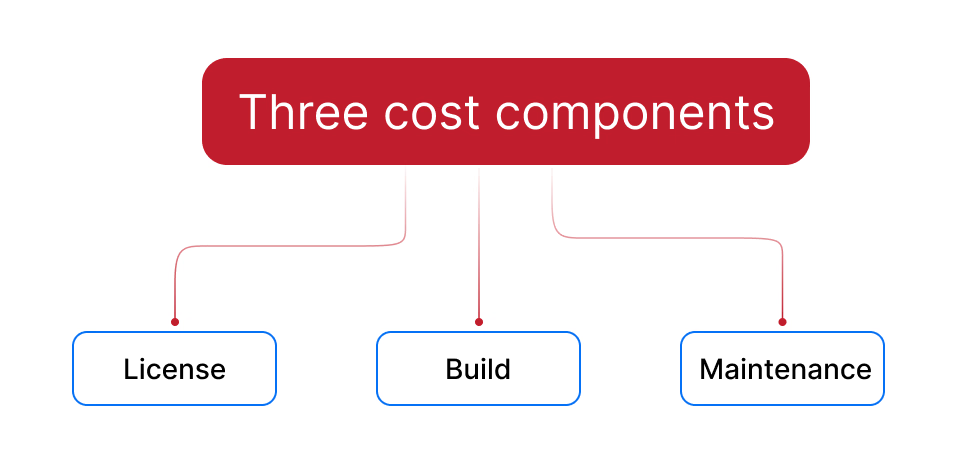
Three cost components, and the license is the one buyers overweight.
License. SOAR has its own licensing. Visible and easy to budget.
Build. Every playbook is a small software project: design, build, test, and validate against real events. The first few playbooks carry the steepest cost because you are also establishing patterns and integrations. This is real professional-services effort, not a configuration afternoon.
Maintenance. This is the cost that surprises people and sinks neglected deployments. Playbooks break when the tools they orchestrate change, when APIs update, when your environment shifts. A SOAR deployment is a living thing that needs ownership. An unmaintained playbook is worse than no playbook, because people trust it until the day it silently fails.
The maintenance reality is why many organizations run SOAR under a managed arrangement, so playbook upkeep is somebody's defined job rather than an afterthought. That model is covered in Splunk Managed Services: What's Included and What's Not.
7. SOAR and the rest of your Splunk stack
SOAR is the response layer, and it works best as part of a chain rather than alone.
Detection happens in Splunk Enterprise Security. ES produces the findings, and risk-based alerting prioritizes them so SOAR receives the ones that matter rather than everything. Response happens in SOAR, which enriches, decides or asks a human to decide, and acts. The way these connect conceptually is the subject of the companion blog How Splunk SOAR, ES, and ITSI Work Together, and the full security operations pipeline, including observability, is in From Threat Detection to Automated Response.
The reason this matters for a SOAR buyer: SOAR is only as good as what feeds it. If ES is noisy and unprioritized, SOAR automates noise. If ES is tuned and risk-scored, SOAR automates signal. This is why a SOAR engagement often starts with a look at what is upstream, covered in bitsIO's Splunk Enterprise Security work.
8. How to tell if you are ready
A short readiness test, sharper than a feature comparison.
You are ready if: you have identifiable high-volume repeatable tasks eating analyst time, your detection layer produces reasonably prioritized alerts, your response processes exist as agreed steps you could write down, and someone will own playbook maintenance. That last point is the gate most teams fail.
You are not ready if: your alerts are noisy and unprioritized, your response processes live only in individual analysts' heads, or you are hoping SOAR will impose order on a chaotic SOC. It will not. It codifies order that already exists.
If you are not ready, the highest-value step is usually upstream: tune detections, agree runbooks, prioritize alerts. Then SOAR has good process and real volume to amplify.
9. How bitsIO delivers SOAR services
bitsIO is a four-time Splunk Partner of the Year and a Splunk Elite Partner, with 300+ enterprise clients and 50+ Splunk certifications across the team. For SOAR, the relevant discipline is knowing what to automate and in what order, because as this guide has argued, the ROI is entirely in that choice.
A bitsIO SOAR engagement starts with candidate scoring, not playbook building. Tasks are ranked on volume, repeatability, and judgment, so the first playbooks are the ones that return the most analyst time for the least maintenance risk. Response actions follow enrichment, often behind approval gates until trust is established. Case management is set up as a first-class concern, not an afterthought, because consistent, documented investigation raises quality whether or not a step is automated.
Where a data or use-case question is in scope, datasensAI helps direct effort: it scores data by utilization using its algorithm, produces ROI and cost analysis, and generates 10 to 15 MITRE ATT&CK-aligned use-case recommendations, which maps naturally onto deciding which detections deserve automated response. The specific playbook patterns bitsIO deploys are documented in Splunk SOAR Playbook Patterns That Cut MTTR, and SOAR sits within bitsIO's broader Splunk SOAR practice.
10. Frequently asked questions