Traditional observability was built toanswer "what broke?" in deterministic software. AI agents arenon-deterministic, so the same request rarely follows the same path twice. Thatshift created a trust gap: teams can see that an agent ran, but not whether itwas right, safe, or worth the cost. Splunk frames the answer as four pillars ofagent observability.

Trace a request end to end, from the agent and model to vector databases, model-serving endpoints, and the GPUs underneath. Correlating these signals in one view means you find the root cause of a failure in minutes, instead of learning about it from user complaints.

Score outputs for hallucination, bias, toxicity, and relevance on live traffic, not just a sample. Splunk notes that an untuned model acting as a judge reaches only about 70 percent accuracy, so roughly one in three scores can be wrong. Purpose-built small language models make accurate evaluation affordable at production scale.

Splunk reports that a single agent interaction can consume tens of thousands of tokens. Tokenomics attributes that spend to specific agents, workflows, and models, and pairs it with output quality, so you can tell which agents return real value and which simply run up the bill.

Turn trusted evaluations into runtime guardrails that block prompt injection, data leakage, and tool misuse before an action reaches the user. This keeps agents compliant and aligns with OWASP guidance for agentic AI security. bitsIO keeps this capability general under AI Agent Security.
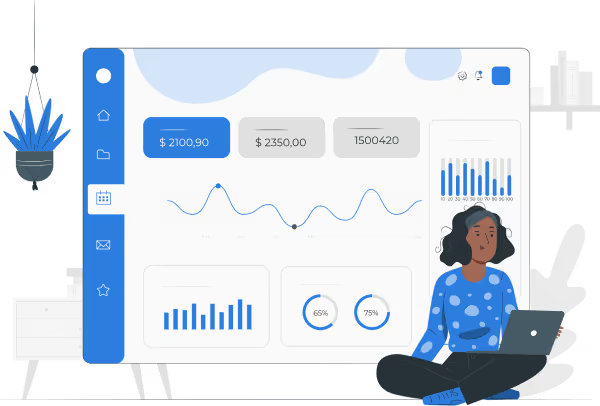
As agents scale, token spend can climb faster than the value they return. Finance sees the invoice while engineering sees the sprint activity, and connecting the two is hard. Agent observability attributes token spend to specific agents and workflows, so both teams work from the same numbers and runaway cost is caught early.
bitsIO is a 5x Splunk Partner of the Year and Splunk Elite Partner with 300+ enterprise clients. Our Splunk professional services team helps enterprises move agent observability from a pilot to production, then operate it day to day.

bitsIO reviews how your agents run today, where observability gaps sit, and which signals matter most for your use case, then maps a practical path to production.

We instrument your agents and models and connect them to the data you already collect in Splunk and Splunk Observability, so agent behavior shows up alongside your existing telemetry.

bitsIO brings agent behavior, token cost, and infrastructure health into one correlated view. The approach is platform agnostic, so we can fold in Grafana and other data platforms rather than locking you to a single tool.

We set up evaluations for the quality and safety signals that matter to you, promote the trusted ones into runtime guardrails, and help your team tune them and right-size models against cost as your AI footprint grows.
.avif)

Agent observability is the practice of watching AI agents, and the models and infrastructure behind them, in production. It tracks four things: performance, output quality, token cost, and safety. The goal is to see whether agents work as intended, what they cost, and where they create risk.
Traditional monitoring tracks uptime, latency, and errors in deterministic software. AI agents are non-deterministic, so the same request can take a different path each time. Agent observability adds output quality, hallucination and safety checks, and token cost to the usual signals, and correlates them across the whole AI stack.
Tokenomics is the tracking of how many tokens your agents consume and what that spend delivers. Splunk reports that a single agent interaction can run to tens of thousands of tokens. Without visibility, cost climbs without matching value. Tracking token use by agent and workflow ties AI spend to business outcomes.
Guardrails are runtime controls that block unsafe or inaccurate agent actions before they reach the user, including prompt injection, data leakage, and tool misuse. Observability comes first, since you cannot block what you cannot see. bitsIO keeps this capability general under AI Agent Security.
bitsIO is a four-time Splunk Partner of the Year and Splunk Elite Partner. Our professional services team helps you implement agent observability on Splunk: evaluate agent behavior, trace workflows down to the infrastructure, track token cost, and apply guardrails across production traffic.
Yes. bitsIO anchors agent observability on Splunk and Splunk Observability, and correlates signals from Grafana and other data platforms. The approach is platform agnostic, so you get one view of agent behavior, cost, and risk without being locked to a single tool.
A typical engagement covers an assessment of your AI stack, implementation on Splunk, correlation of agent behavior with cost and infrastructure, and setup of evaluations and runtime guardrails. bitsIO then helps your team operate and tune it over time.
A bitsIO engineer will review how your agents run today and map a path to full-stack agent observability on Splunk.

We're a team of passionate experts helping businesses like yours extract maximum value from their data investments. Whether you need to streamline data pipelines, build AI-powered solutions, or unlock advanced analytics, we have the expertise to guide you through every step.




Copyright © 2026 bitsIO | All Rights Reserved.
.avif)