
Summarize the Content of the Blog





Managed Splunk services are ongoing, SLA-backed engagements where a certified provider operates your Splunk environment: monitoring platform health, managing content and data sources, applying upgrades, optimizing license costs, and responding to incidents around the clock. They make sense when your team cannot staff 24/7 Splunk coverage internally, when skills gaps are affecting security or observability outcomes, or when the total cost of an in-house team exceeds what a managed provider charges for equivalent coverage.
The case for outsourcing Splunk operations is getting stronger. ISC2's 2025 Cybersecurity Workforce Study found that 95% of cybersecurity teams report at least one skills gap, with 59% describing those gaps as critical or significant, up from 44% in 2024 [1]. Gartner projects managed security services will grow at 11.1% in 2026, the fastest rate in the security services segment, driven by organizations that cannot hire fast enough [2].
Key Takeaways
A 24/7 in-house Splunk team requires 4 to 5 FTEs at $400K to $600K per year. Managed services typically cost 40 to 60 percent of that for equivalent or better coverage .
95% of cybersecurity teams report skills gaps in 2025 (ISC2). Skills shortages now outpace headcount as the top workforce challenge .
Managed services cover platform operations, content management, cost optimization, and incident response under defined SLAs. Custom development and major redesigns are typically excluded.
Co-managed models split responsibilities: the MSP handles platform operations while your team retains strategic control over use cases and detection content.
Managed Splunk providers routinely deliver 15 to 25 percent ingest cost reductions through data tiering, filtering, and SmartStore optimization .
Gartner's January 2026 Market Guide for Outsourced Managed Security Services confirms growing enterprise demand for this model.
What Are Managed Splunk Services?
Managed Splunk services are ongoing operational engagements where a Splunk-certified provider takes responsibility for running your Splunk environment under a service-level agreement. The scope typically covers Splunk Enterprise, Splunk Cloud, and premium products like Enterprise Security, SOAR, ITSI, and Observability Cloud.
The managed model differs from project-based Professional Services in a fundamental way. Professional Services are time-bound: a partner deploys, configures, and hands off. Managed services are continuous: a provider monitors, maintains, optimizes, and responds to incidents on an ongoing basis. For a detailed comparison of these models, see Splunk Professional Services vs. Partner Services.
Organizations most likely to benefit include teams that cannot cover nights and weekends, environments scaling beyond one or two administrators, compliance-heavy industries requiring documented uptime and audit trails, and companies migrating to Splunk Cloud or adopting Observability Cloud alongside existing on-premises deployments.
In-House Splunk vs. Managed Splunk: The TCO Math
The outsourcing decision often comes down to numbers. Here is how the costs compare.
Splunk's State of Security 2025 adds context: 46% of SOC staff spend more time maintaining tools than defending the organization [5]. Managed services free internal teams to focus on threat hunting, detection engineering, and business outcomes instead of platform upkeep.
When in-house is the right call
If your organization already has 3 or more senior Splunk administrators, stable headcount, and a long-term investment in security or observability, running Splunk in-house can work. Most organizations do not check those boxes. They start in-house, hit a plateau, lose a key person, and call a partner anyway.
What Is Included in a Managed Splunk Engagement?
Managed Splunk engagements cover three categories: platform operations, data and content management, and cost optimization. Understanding what is and is not included prevents scope gaps mid-contract.
Platform operations
Forwarder, indexer, and search head health monitoring. Performance tuning (search optimization, bucket sizing). Capacity planning based on ingest trends. Scheduled upgrades and patching with pre-production validation. Backup and disaster recovery runbooks. License utilization tracking against entitlement.
Data and content management
Data source onboarding with CIM normalization. App and add-on lifecycle management. Dashboard, alert, and report maintenance. Correlation search tuning to reduce false positives. Notable triage workflows and escalation paths for security alerts.
Cost and license optimization
Ingest filtering for noisy, low-value sources. Retention tier management (hot, warm, cold, frozen) aligned to compliance needs. SmartStore configuration. License pool allocation across business units. Monthly cost-per-source reporting.
bitsIO's datasensAI adds a layer most managed providers do not offer: data scoring, ROI and cost analysis, and MITRE ATT&CK-aligned use-case recommendations (10 to 15 specific use cases per engagement). It shows exactly which data sources are earning their ingest cost and which ones are sitting unused.
What is typically not included
Custom application development, major architecture redesigns, structured training programs, and forensic investigations are usually scoped separately. Clarify these boundaries before signing.
24/7 On-Call vs. Business-Hours Support
Managed Splunk providers offer tiered support. The right tier depends on your risk profile, regulatory requirements, and what happens when Splunk goes down outside business hours.
If your organization runs Enterprise Security as your primary SIEM, business-hours-only support creates a detection gap every night and weekend. For ES-dependent environments, 24/7 coverage is the baseline, not a premium add-on.
Hybrid Models: Co-Managed Splunk
Co-managed Splunk splits responsibilities between your internal team and the managed provider using a RACI matrix. This model works for organizations that want to retain strategic control over detection content and use-case prioritization while offloading platform infrastructure.
The MSP typically owns: Platform health, upgrades, capacity planning, incident response for platform issues, license management, and data source onboarding.
Your team typically owns: Use-case backlog, detection content authoring, business logic in dashboards, data source selection, and compliance reporting interpretation.
Joint accountability: Weekly change advisory boards, emergency change windows, escalation paths for cross-functional incidents, and quarterly roadmap reviews.
The co-managed model only works if responsibilities are documented before the engagement starts. Weekly syncs, shared ticketing, and clear escalation paths prevent the most common failure: nobody owns the problem during an incident.
How to Evaluate a Managed Splunk MSP
Use these five criteria to compare providers. For a deeper framework with specific questions, see 9 Questions to Ask Any Splunk Implementation Partner.
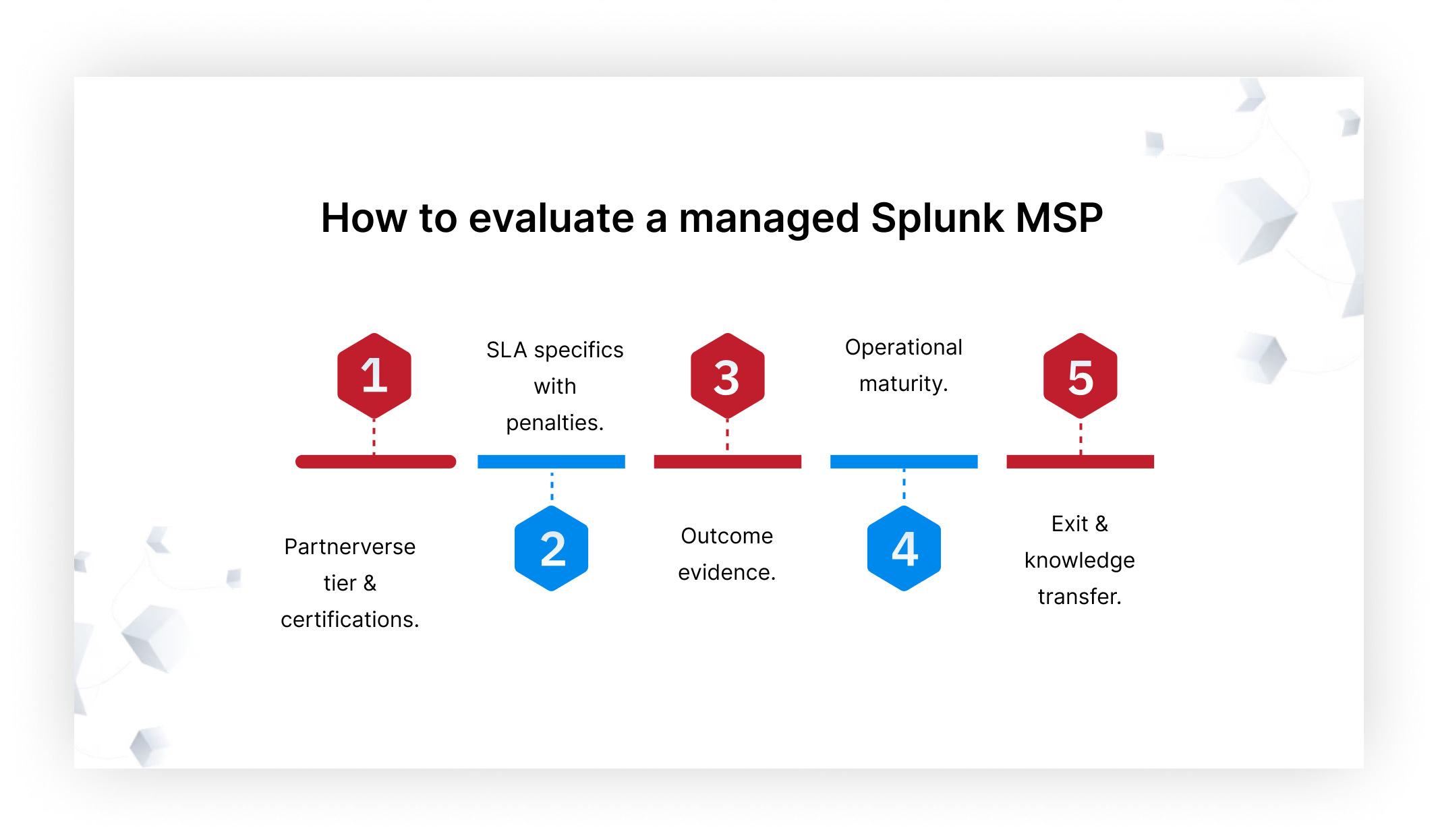
- Partnerverse tier and certifications. Verify at splunk.com/partners. Ask for certified consultant headcount by product area and how recently credentials were renewed.
- SLA specifics with penalties. Request the actual SLA document. Look for availability targets (99.9% standard), response times by priority, and financial penalties for breaches.
- Outcome evidence. Three references matching your industry, ingest volume, and product mix. Useful metrics: MTTR reductions, cost savings, uptime track records.
- Operational maturity. Request sample runbooks, a change management process, and a monthly report template. These reveal process maturity.
- Exit and knowledge transfer. Confirm what happens when the engagement ends. Who owns configurations, dashboards, and playbooks? Unclear exit terms create dependency.
bitsIO is a four-time Splunk Partner of the Year and Splunk Elite Partner with 300+ enterprise clients. We offer fully managed and co-managed Splunk services with transparent SLAs, named delivery teams, and datasensAI-powered cost optimization.
Frequently Asked Questions