Summarize the Content of the Blog





Splunk SIEM consulting helps organizations move from a legacy or underperforming SIEM to Splunk Enterprise Security, then build the use cases and detection content that make the new SIEM deliver. The work covers migration planning, data source and content mapping, use-case development, detection tuning, and validation that the new environment matches or exceeds the coverage of the old one. The hard part is not moving data. It is making sure detection coverage does not regress during the move.
Splunk remains a market leader in this space. It was named a Leader in the Gartner Magic Quadrant for SIEM for the tenth consecutive time and ranked the number one SIEM provider by IDC for the fifth year running [1]. That leadership, plus the agentic AI capabilities in ES 8.x, is why many organizations consolidate onto Splunk. This guide is about doing that migration well.
If you already run Splunk ES and want to strengthen an existing SOC rather than migrate, start with Splunk Security Professional Services: Strengthen Your SOC in 2026.
Key Takeaways
SIEM migration risk concentrates in one place: detection coverage regressing during the move. A good migration maps use cases first, then data.
Do not lift and shift old rules blindly. Legacy correlation rules often carry years of tuning debt; migration is a chance to modernize detections.
Use-case development is the core of SIEM value: mapping the threats you need to detect to the data and detections that catch them.
Splunk was named a Leader in the Gartner Magic Quadrant for SIEM for the tenth consecutive time and the number one SIEM by IDC for the fifth year.
A phased migration with parallel-run validation protects coverage; a big-bang cutover risks blind spots.
Detection content is not a one-time deliverable. Plan for ongoing tuning after the migration completes.
What Is Splunk SIEM Consulting?
Splunk SIEM consulting is expert guidance for planning, migrating, and operating Splunk Enterprise Security as your security information and event management platform. It spans two related jobs: getting onto Splunk (migration from a legacy SIEM or a first-time SIEM build) and getting value from it (use-case development and detection engineering).
The distinction matters because most SIEM disappointment comes from treating the platform as the deliverable. Splunk ES installed is not a working SOC. The consulting work that turns the platform into detection coverage, tuned alerts, and analyst workflows is where the value lives.
Why Organizations Migrate to Splunk
Organizations consolidate onto Splunk ES for a few consistent reasons.
- Consolidation. Running security and observability on one platform removes tool sprawl. Splunk is the only vendor named a Gartner Leader in both SIEM and Observability, which appeals to teams unifying operations.
- Detection capability. Risk-Based Alerting, MITRE ATT&CK alignment, and the agentic AI features in ES 8.x offer detection sophistication that older SIEMs struggle to match.
- Scale and flexibility. Splunk's heritage handling large data volumes suits organizations whose legacy SIEM strains under modern log volume.
- Cost and licensing pressure. Some migrations are driven by unsustainable licensing on an incumbent tool. Splunk cost optimization is part of the business case, covered in How to Reduce Splunk Licensing Costs with datasensAI.
The SIEM Migration Risk: Coverage Regression
Here is the risk that matters most in any SIEM migration: during the move, you can end up detecting less than you did before. A rule that existed in the old SIEM has no equivalent in the new one yet. A data source is not onboarded. A detection fires but nobody is watching it. For a window of time, the organization is less secure than it was, and often nobody realizes it.
Map use cases before data
The single most important migration principle is to inventory the use cases your current SIEM covers before you move any data. What is each rule detecting? Which are actually useful? What is the equivalent in Splunk ES? This use-case inventory becomes the coverage checklist you validate against. Skip it, and you migrate blind.
This is why coverage-first migration planning beats data-first. The question is never just how do we get the logs into Splunk. It is which detections must keep working, and how do we prove they still do.
A Phased SIEM Migration Approach
A phased migration protects coverage. The phases below are the pattern experienced consultants follow.
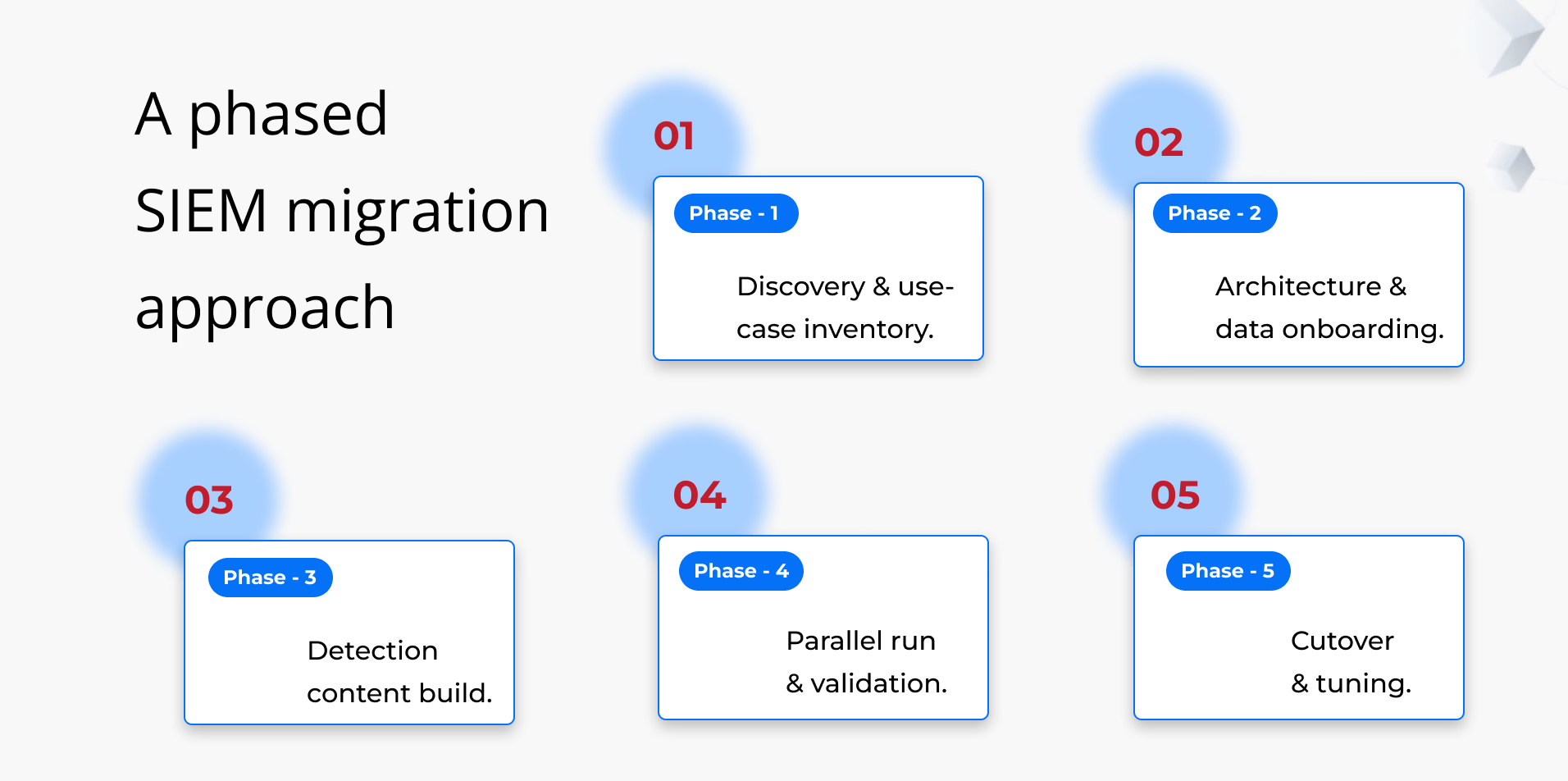
- Phase 1: Discovery and use-case inventory. Catalog current data sources, correlation rules, and the use cases they support. Identify what to migrate, modernize, or retire.
- Phase 2: Architecture and data onboarding. Stand up the Splunk ES environment, onboard security data sources, and validate CIM normalization so detections work across data types.
- Phase 3: Detection content build. Build the priority detections in Splunk, mapped to MITRE ATT&CK, and implement Risk-Based Alerting.
- Phase 4: Parallel run and validation. Run both SIEMs in parallel, comparing what each detects, until you have confidence the new environment matches or exceeds coverage.
- Phase 5: Cutover and tuning. Decommission the legacy SIEM and shift to ongoing tuning of the Splunk detections.
The parallel-run phase is what separates a safe migration from a risky one. It is tempting to skip to save time, but it is the only way to prove coverage did not regress.
Use-Case Development: The Heart of SIEM Value
A SIEM use case is a specific threat scenario you want to detect, plus the data and detection logic that catch it. Examples: detecting credential stuffing, identifying lateral movement, spotting data exfiltration. Use-case development is the discipline of building these systematically.
The process starts from risk, not from data. Which threats matter most to your organization, given your industry, assets, and threat model? Those priorities drive which use cases you build first. Then, for each use case, you identify the data sources required, build the detection, map it to MITRE ATT&CK, and tune it against your environment.
bitsIO's datasensAI supports this by providing MITRE ATT&CK-aligned use-case recommendations, typically 10 to 15 specific use cases per engagement, along with data scoring that shows whether the data those use cases need is present and usable. This turns use-case planning from a whiteboard exercise into an evidence-based roadmap.
Modernizing Detections Instead of Lifting and Shifting
A migration is a rare opportunity to fix accumulated detection debt. Legacy SIEMs often carry hundreds of rules, many of which are noisy, redundant, or no longer relevant. Copying them all into Splunk imports the noise along with the coverage.
The better approach uses migration as a modernization checkpoint. For each legacy rule, ask: is this still relevant? Is there a more effective Splunk-native way to detect this, such as an RBA risk rule instead of a standalone correlation search? Should this be mapped to a MITRE ATT&CK technique for coverage tracking? The result is a leaner, higher-fidelity detection set rather than a transplanted mess.
Validating the Migration
A credible SIEM migration proves its coverage. Validation should be explicit and documented.
How to Choose a SIEM Consulting Partner
SIEM migration is high-stakes work. Use these signals, and see the full framework in 9 Questions to Ask Any Splunk Implementation Partner.
- Migration track record. Ask for examples of migrations from your specific legacy SIEM, and how they handled parallel-run validation.
- Use-case development method. Confirm they have a structured, risk-driven approach to use-case development, not just rule translation.
- Detection engineering depth. Look for RBA and MITRE ATT&CK experience, not just data onboarding skills.
- Coverage validation discipline. A partner who insists on a use-case coverage matrix and parallel run is protecting you.
bitsIO is a four-time Splunk Partner of the Year and Splunk Elite Partner. We deliver SIEM migrations to Splunk ES with coverage-first planning, use-case development, detection modernization, and parallel-run validation, supported by datasensAI for use-case mapping and data readiness.
Frequently Asked Questions