
Summarize the Content of the Blog





Managed Splunk services cover the ongoing, day-to-day operations that keep your Splunk environment healthy after the initial deployment is done. That includes platform monitoring and maintenance, data source onboarding and CIM normalization, content management (alerts, dashboards, correlation searches), version upgrades, license optimization, and SLA-backed incident response. Most managed Splunk providers operate 24x7, though business-hours and co-managed models are also common.
This guide breaks down what a managed Splunk engagement actually delivers, how SLA tiers work, what pricing models look like, and how co-managed models split responsibilities. If you have already decided that managed services make sense for your team (see Managed Splunk Partner vs. In-House: Cost, Risk, and Value for that comparison), this is the next step: understanding exactly what you are buying.
Key Takeaways
Managed Splunk services cover platform ops, content management, upgrades, license optimization, and SLA-backed incident response. Clarify what is included before signing.
Standard SLAs target 99.9% platform availability with P1 response times of 15 to 30 minutes. Tiered service models (business hours, 24x5, 24x7) affect pricing and coverage.
Common pricing models include percentage of Splunk license (15 to 30%), per-node fees, per-GB ingest fees, and flat monthly retainers. Compare against fully loaded internal team costs.
Co-managed models split platform operations (MSP) from content and use-case ownership (your team). A clear RACI matrix prevents confusion during incidents.
Organizations with 200+ GB/day ingest or 20+ nodes typically find managed services cost-competitive with internal teams .
ISC2 reports a global cybersecurity workforce gap of 4.8 million professionals, making it harder to staff Splunk operations internally.
What Are Managed Splunk Services?
Managed Splunk services are ongoing, SLA-governed operations delivered by a specialized provider (MSP) to run your Splunk environment after it has been deployed. They cover Splunk Enterprise, Splunk Cloud, and premium apps including Enterprise Security (ES), SOAR, ITSI, and Observability Cloud.
The core difference between managed services and professional services is duration and scope. Professional services are project-based: deploy, configure, hand off. Managed services are continuous: monitor, maintain, optimize, respond. For a detailed comparison, see Splunk Professional Services vs. Partner Services.
Organizations turn to managed Splunk services when their internal team cannot cover 24x7 operations, when they are scaling beyond one or two Splunk administrators, when compliance requirements demand guaranteed uptime and incident response times, or when the cost of hiring and retaining certified Splunk professionals exceeds the cost of outsourcing. ISC2's 2024 Cybersecurity Workforce Study puts the global workforce gap at 4.8 million professionals, with 90% of organizations reporting skills shortages . That talent gap makes managed services a practical necessity for many teams.
What Is Included in a Managed Splunk Engagement?
Most managed Splunk agreements cover three categories of work: platform operations, data and content operations, and cost and license management. Here is what each includes.
Platform operations
- Health monitoring: Continuous monitoring of forwarders, indexers, search heads, and deployment servers. Automated alerting for performance anomalies, disk capacity, and replication lag.
- Performance tuning: Search optimization, index bucket management, scheduled search staggering, and concurrency management to keep search times fast as data volumes grow.
- Capacity planning: Proactive scaling recommendations based on ingest growth trends, search load patterns, and storage utilization. Prevents performance degradation before it affects users.
- Upgrades and patching: Quarterly or biannual version updates planned and executed with rollback procedures. Includes compatibility testing for apps, add-ons, and custom configurations.
- Backup and disaster recovery: Runbook execution for backup validation, replication health checks, and DR failover testing on a defined schedule.
Data and content operations
- Data source onboarding: New source integration with field extraction, timestamp parsing, and CIM normalization so data is immediately usable for correlation searches and dashboards.
- Content management: Ongoing maintenance of alerts, dashboards, reports, correlation searches, and saved searches. Includes tuning alert thresholds to reduce noise and false positives.
- App lifecycle management: Updates, deprecation tracking, and compatibility testing for Splunkbase apps and custom add-ons.
- Data quality monitoring: Field extraction accuracy checks, sourcetype hygiene validation, and CIM compliance audits to maintain data integrity over time.
Cost and license management
- Ingest optimization: Filtering, sampling, and routing rules to reduce unnecessary data volume without losing visibility. Strong managed providers target 15 to 25% ingest cost reduction year over year.
- Retention management: Hot, warm, cold, and frozen tier configuration to balance search performance against storage costs.
- License tracking: Daily license utilization monitoring with alerts for approaching limits. License pool allocation across business units to prevent overages.
- SmartStore configuration: S3-backed warm bucket management for Splunk Cloud environments to reduce storage costs.
SLA Tiers: 24x7 On-Call vs. Business-Hours Support
Managed Splunk providers typically offer tiered service levels. The right tier depends on your uptime requirements, compliance obligations, and budget.
For regulated industries (healthcare, financial services, public sector), 24x7 coverage with P1 response times of 15 minutes or less is typically a compliance requirement, not a luxury. If your organization runs Splunk Enterprise Security as its primary SIEM, plan for 24x7 coverage.
How Managed Splunk Services Are Priced
Pricing models vary across providers. Understanding the options helps you compare proposals accurately and avoid surprise costs
When comparing managed services against internal operations, factor in the fully loaded cost of 2 to 4 full-time Splunk administrators ($100K to $150K salary each, plus benefits), 24x7 on-call coverage costs, annual training and certification ($5K to $10K per person), and the monitoring and automation tools that MSPs include in their service. Organizations with 200+ GB/day ingest or 20+ nodes typically find managed services cost-competitive with internal teams .
Hidden costs to watch
- Onboarding and knowledge transfer: One-time fees of $10K to $50K depending on environment complexity.
- Out-of-scope work: Custom integrations, major architecture changes, and new product deployments are usually billed separately.
- Contract terms: Minimum commitments of 12 to 36 months are common. Check early termination penalties and auto-renewal clauses.
- Data egress: For Splunk Cloud environments, data egress charges from cloud providers can add up. Clarify who absorbs these costs.
Co-Managed Splunk: When to Split Responsibilities
Not every organization needs to hand over full operational control. Co-managed models let you keep ownership of content, use cases, and business logic while the MSP handles platform operations, infrastructure, and 24x7 monitoring.
A typical co-managed RACI looks like this:
Co-managed models work well for organizations that have internal Splunk expertise but lack 24x7 bench depth. Your team keeps strategic control and content ownership; the MSP covers the operational workload that burns out small teams. The key is documenting this split clearly before the engagement starts, including emergency contact trees, escalation matrices, and approval workflows for changes.
How to Evaluate a Managed Splunk Provider
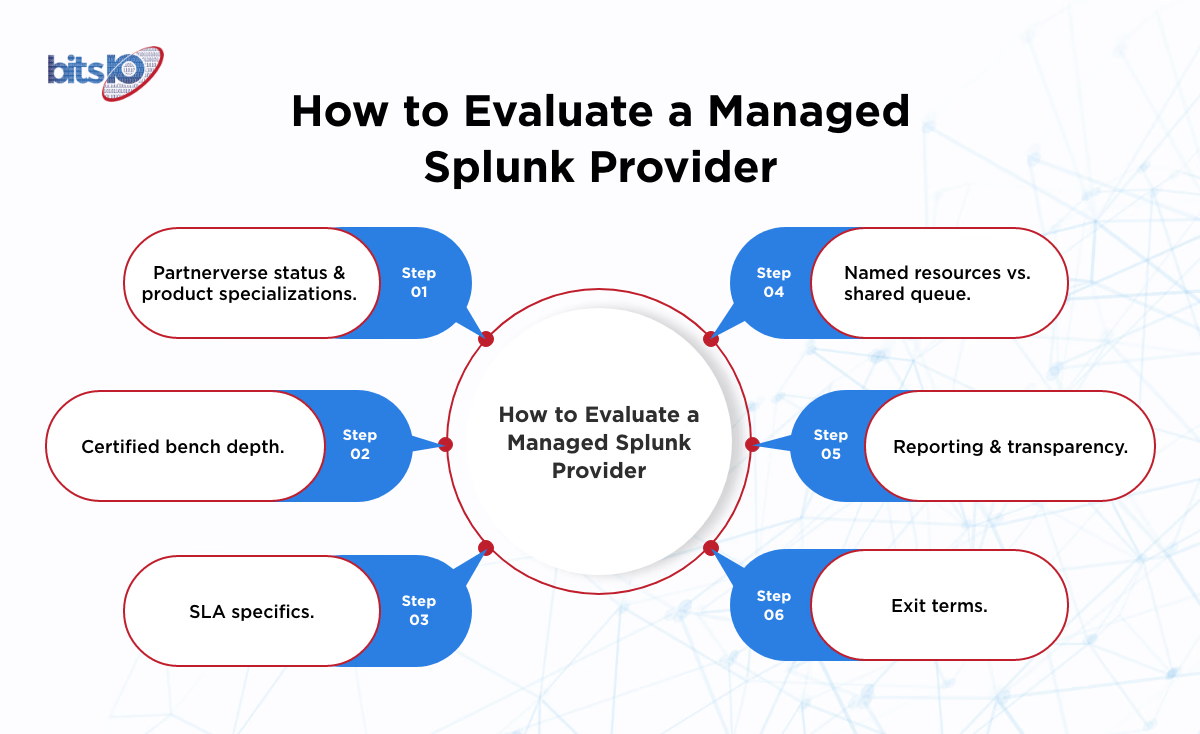
Use these criteria to compare providers. For a detailed partner evaluation framework with 9 specific questions, see How to Choose a Splunk Implementation Partner.
- Partnerverse status and product specializations. Verify independently at splunk.com/partners. Specializations in Enterprise Security, ITSI, or Observability Cloud signal depth beyond basic platform administration.
- Certified bench depth. Ask for the number of certified consultants available for your engagement, not total company headcount. Confirm certifications are current (within 18 months).
- SLA specifics. Request documented SLA definitions, not marketing summaries. Look for P1/P2/P3 response and resolution times, financial penalties for missed targets, and sample monthly reports.
- Named resources vs. shared queue. Dedicated engineers who know your environment deliver better outcomes than a pooled support desk. Ask whether you will have named resources and what happens when they are unavailable.
- Reporting and transparency. Monthly health reports with KPI dashboards and quarterly business reviews with trend analysis and recommendations should be standard. If the provider does not offer these, their operational maturity is questionable.
- Exit terms. Confirm knowledge transfer provisions, documentation deliverables, and transition timelines. Avoid providers who resist including exit clauses in the agreement.
How bitsIO Delivers Managed Splunk Services
bitsIO is a four-time Splunk Partner of the Year and Splunk Elite Partner with 300+ enterprise clients. Our managed services cover the full Splunk portfolio:
- Coverage models: 24x7, business hours, and co-managed with RACI-defined responsibility splits. Named delivery pods with documented continuity plans.
- Platform scope: Splunk Enterprise, Splunk Cloud, Enterprise Security, ITSI, SOAR, and Observability Cloud. We manage the full stack, not just the core platform.
- Cost optimization: datasensAI provides data scoring, ROI and cost analysis, and MITRE ATT&CK-aligned use-case recommendations (10 to 15 specific use cases per engagement) to identify underutilized data and close visibility gaps.
- Industry depth: Pre-built operational frameworks for healthcare (HIPAA compliance logging), financial services (SOX and PCI reporting), manufacturing (OT/IT convergence monitoring), and public sector environments.
- SLA commitments: P1 response within 15 minutes for 24x7 engagements. Monthly health reports with KPI dashboards. Quarterly business reviews with optimization recommendations.